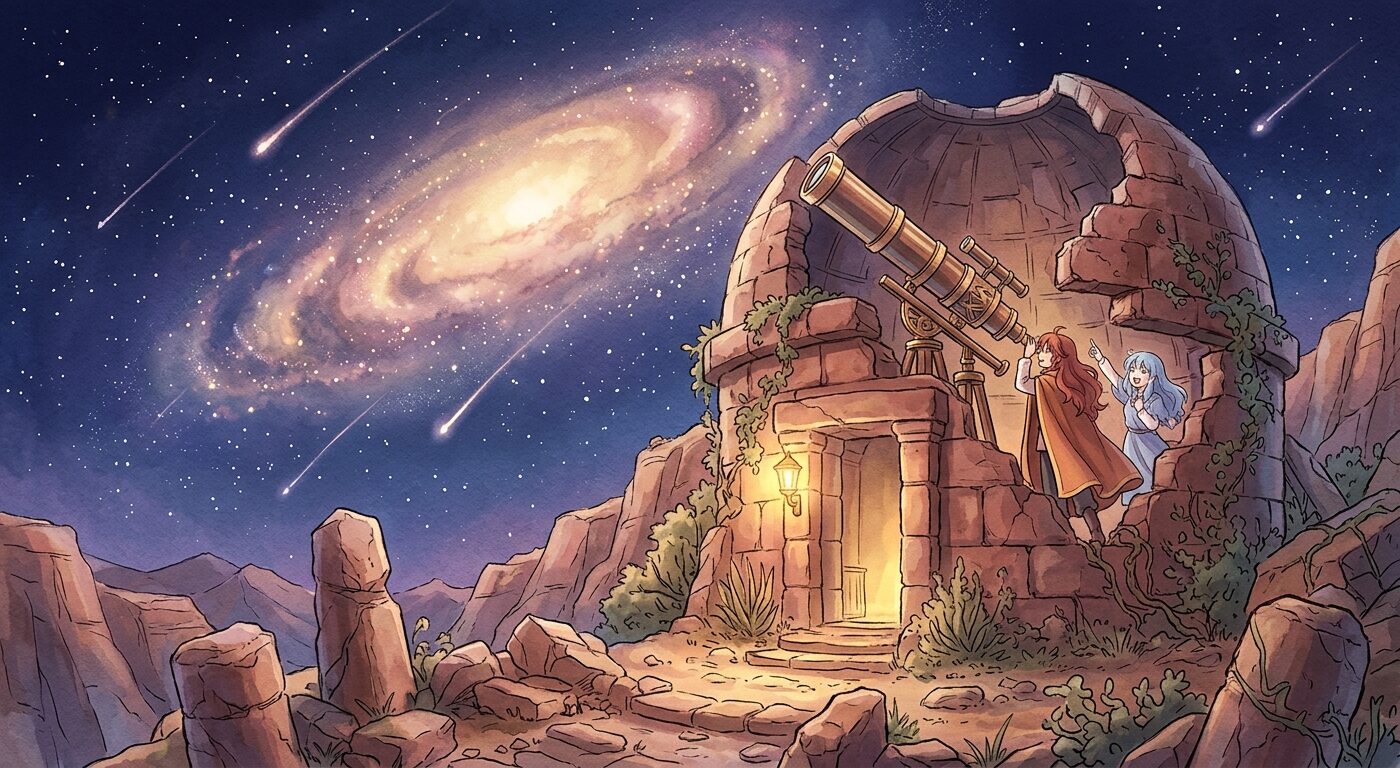
The old glass lens, cool beneath my fingers, offered no resistance to the truth of the night. This was where the world thinned, where the breath of the plateau met the silence of the void, and every dust mote dancing in the telescope’s beam became a distant star. For sixty years, I, Jari, have been the last sentinel of this place, the High Observatory of the Whispering Peaks, a crumbling palimpsest of forgotten cosmography etched into the very bone of the mountain. Generations before me built it, generations after will forget it, but tonight, it is mine.
The wind, a dry, patient sculptor, hummed through cracks in the domed roof, a lullaby of erosion. It carried the scent of sun-baked stone and distant, hardy desert flora. Inside, the air was thick with the scent of old brass and the ghosts of countless celestial observations. My hands, gnarled and slow, moved with an instinct born of repetition, turning the ancient gimbals of the great telescope, aligning the heavy tube with the constellation of the Serpent Bearer. Every click, every grind of aged gears, was a language I understood better than any spoken word.
Through the eyepiece, the universe spilled forth, a diamond dust on black velvet. My own reflection, a slender, elderly non-binary person, barely visible in the corner of the view, seemed as ephemeral as the cosmic dust clouds I was charting. What did my meticulous logs matter? What significance did my hand-drawn maps of nebulae, my careful annotations of comet paths, hold against such indifferent, terrifying beauty? The answers, I knew, were not for me to find in this lifetime. They were folded into the very fabric of time, in the slow dance of galaxies, in the verdigris skin of ages that coated the observatory’s instruments.
I leaned back from the lens, letting my eyes adjust to the dim glow of my oil lamp. The walls around me were covered in charts, some my own, others centuries old, their parchment yellowed and brittle. The faint, almost indistinguishable glyphs carved into the stone pillars whispered of builders who understood the telluric currents as well as the celestial ones. They believed in a grand weaving, a tapestry where earthly tremors mirrored the cosmic shudders. Perhaps they were not wrong.
A moth, drawn by the lamp, fluttered against the glass, its wings a diaphanous blur. It was a tiny, fragile visitor in a place dedicated to the immense and eternal. I watched it for a long moment, thinking of the fleetingness of all things, of my own small life, a single flicker against the backdrop of infinity. Yet, there was a profound peace in this understanding. The meaning wasn’t in conquering the vastness, but in simply bearing witness to it. In the quiet act of observing, of documenting, of simply being here, under the vault of stars.
My gaze drifted to the highest point of the dome, where a faint, almost humming memory of an ancient signal beacon lay dormant. It had not been lit in centuries, its purpose lost to time, perhaps meant for lost travelers in the great ocean of space, or for a forgotten festival of light. The desert wind picked up again, a low howl, and I pulled my thick, patched wool cloak tighter around me. The cold was a familiar companion, a reminder of the mountain’s constant embrace.
The moon began its slow ascent, a silver coin tossed into the inkwell of the sky, washing out the fainter stars. My work for the night was nearing its end. Another cycle charted, another vigil kept. I blew out the lamp, plunging the chamber into near-total darkness, save for the incredible, unblinking eyes of the universe. In this profound quiet, I felt not lonely, but deeply connected, a single thread in an unending weave.
Before descending into my small sleeping alcove, I paused at the massive, weather-worn entrance. The valley below was a dark, hushed bowl, the distant lights of any human settlement too far to matter. Above, the Milky Way sprawled like spilt cream, a silent promise of untold wonders. My life here was a whisper in the vastness, a fleeting gesture against eternity. But in that whisper, in that gesture, was all the meaning I needed. I was Jari, the Sky-Watcher, and the stars were my kin, my silent conversation, my sublime tranquility. And as dawn approached, painting the eastern horizon with the softest blush of rose and gold, I felt myself merging with the great, slow turning.
What did you think?
Reader Thoughts
No thoughts yet. Be the first to share yours.
Join the conversation
Log in or create a free account to share your thoughts on this story.