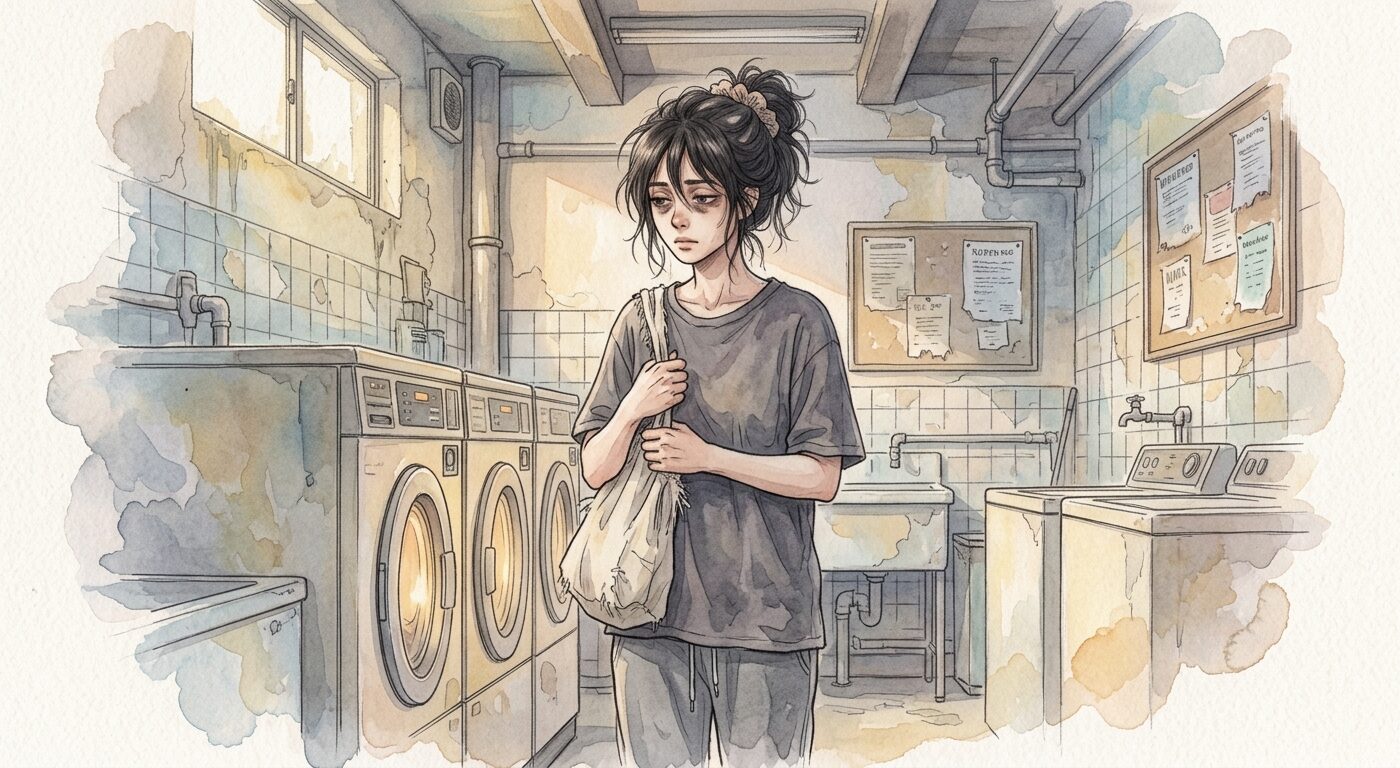
The laundry room, usually a purgatory of warm damp air and forgotten socks, had begun to breathe. Elara Vance blinked, then rubbed at the gritty sleep in her eyes. Three hours, fragmented, was her new baseline. Her daughter, Lyra, a tiny monarch of disrupted sleep, was finally down for a stretch, offering this brief, precious window for the weekly ritual.
“Just laundry,” she murmured, the words feeling foreign in her own mouth, a spell against the encroaching strangeness.
But it wasn’t just laundry. The industrial washing machines, usually lined up like stoic, dented sentinels, seemed to have shifted. The furthest one, a relic from the building’s 1970s glory days, was now closer, its single red knob glowing with an impossible, internal light. The humming cacophony of spin cycles had a new undertone, a faint, wordless melody that picked at the edges of her perception. It was insidious, this creeping alteration of the mundane.
She dumped Lyra’s tiny clothes—babygros, miniature socks, burp cloths—into the nearest machine. The water filling the drum had a faint shimmer, reflecting iridescent patterns on the ceiling where no light fixture should have allowed such an effulgence. Elara watched, hypnotized, as a miniature wooden boat, no bigger than her thumb, bobbed to the surface, its tiny sail a shred of linen. It couldn’t be real. She reached in, her fingers brushing the cool, smooth wood, but just as her grip tightened, the boat dissolved into bubbles.

The dryer cycled, a rhythmic thrum, and the air filled with the scent of chamomile and something else: old paper, forgotten rain. When she pulled out the damp, warm clothes, a tiny, perfectly preserved white sparrow’s feather lay nestled among them. It wasn’t the kind of feather one would find in a city. It wasn’t even the right colour for a sparrow. It seemed to be spun from solidified moonlight, shimmering with an inner light that pulsed in time with her own weary heartbeat.
“Where did you come from?” she whispered, holding the fragile thing up to the fluorescent lights which, she now noticed, seemed softer, warmer, like the last rays of a sun that forgot to set.
The laundry room was changing, or perhaps she was. The posters taped to the peeling paint—rules about fabric softener, forgotten items—were now illustrated with impossible flora and fauna, their text in a script she almost recognized, a language of soft sighs and forgotten lullabies. The lint trap on the old dryer wasn’t just catching fluff anymore. It contained miniature, perfectly formed shells, a button made of polished obsidian, and once, a single, minuscule glass teardrop that glittered with impossible rainbows. Each discovery was an anodyne balm, a tiny burst of wonder against the relentless sameness of her days.
She sat on a plastic stool, watching the spin cycle. The room became a kaleidoscope. The walls pulsed, the floor undulated, and for a moment, the machines were not machines but ancient, sleeping beasts, their gentle rumbling the breath of the building itself. Elara felt no fear, only a strange, surreal tenderness. This was her new reality, a liminal space between waking and dreaming, a place where the exhaustion that blurred the edges of her mind also allowed impossible beauty to seep in.
It was here, amidst the steam and the soft mechanical groans, that the world truly opened to her. It wasn’t about escaping motherhood, or even finding clarity, but about seeing the profound magic embedded in its chaotic, demanding heart. The lint trap, a collector of forgotten fragments, had become an oracle, revealing tiny, luminous truths about the universe she now carried in her arms.
“The smallest things,” she murmured, looking down at the shimmering feather still clutched in her palm, “they hold the most.”
As Lyra’s cry echoed faintly from upstairs, the laundry room slowly settled back into its mundane form. The machines returned to their places, the red knob dimmed, the posters were just old posters. But the feather remained, cool and impossibly bright in her hand. Elara smiled, a genuine, unburdened smile. She folded the last babygro, the scent of chamomile and starlight clinging to its soft fabric. She knew she would be back, and that the laundry room, like her own weary, wonder-filled heart, held more than just clothes.

What did you think?
Reader Thoughts
No thoughts yet. Be the first to share yours.
Join the conversation
Log in or create a free account to share your thoughts on this story.