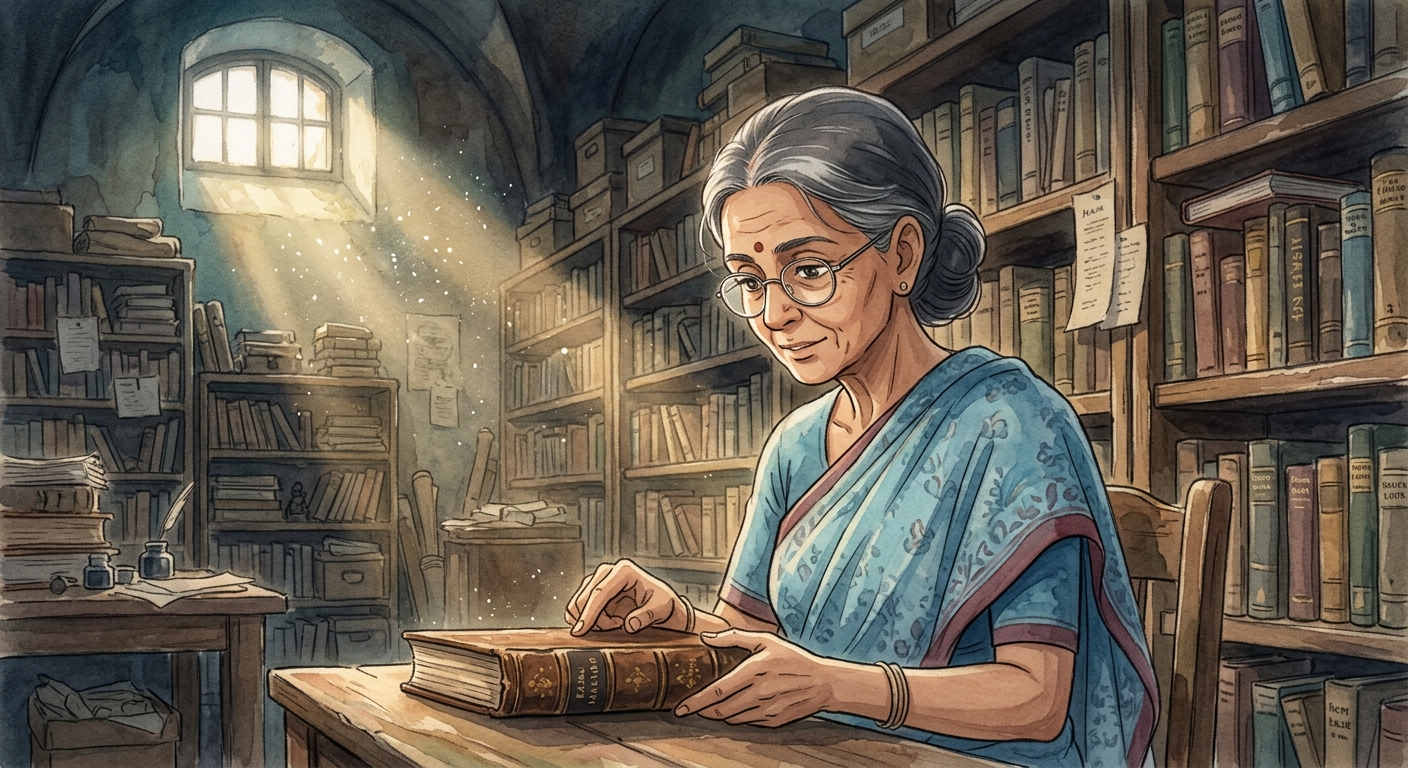
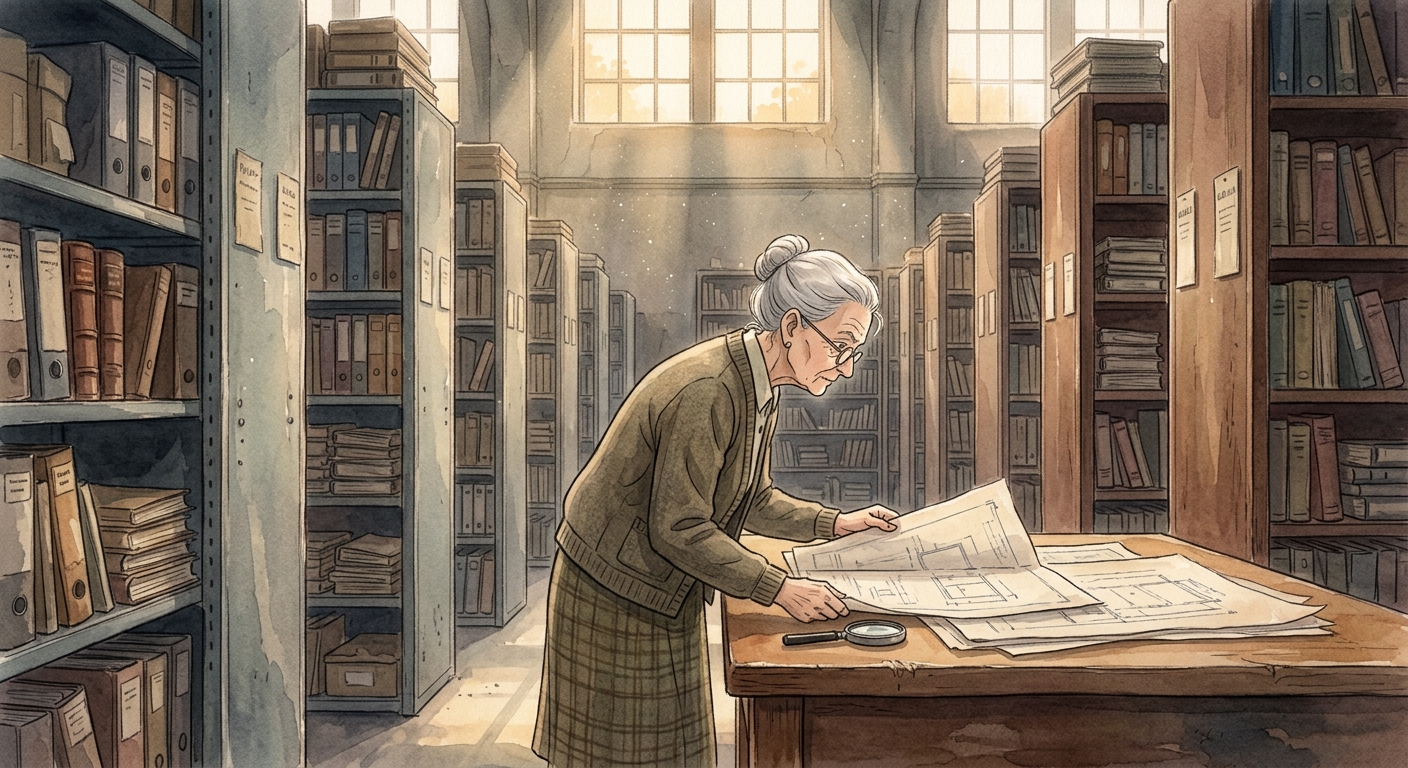
The Municipal Archives, located in the cool, silent sub-basement of the city’s grand library, possessed a peculiar form of temporal resonance, a fact known only to Jaya Malar. Seventy-three years of meticulous cataloging had created not just a record of literature, but a kind of secondary chronicon, subtly charting the eddies and flows of existence itself. Jaya, a slender Indian woman in her late 60s, with silver-streaked dark hair pulled into a neat bun, wearing round spectacles, and a faded cerulean sari, moved between the stacks with the deliberate grace of a priestess attending an ancient, living shrine. Each book, each card, a quiet heartbeat in the vast, subterranean labyrinth.
Her current obsession was the ‘Lost Atlases’ shelf, Section 14, Row H. Specifically, a 17th-century French text titled Cartographie des Mondes Impossibles. Its metadata card, usually a sterile testament to date and provenance, occasionally flickered in her mind’s eye – not with actual visual distortions, but with a feeling of disquiet. A subtle skip in its listed acquisition date, a whisper of a publication year that didn’t quite align with known history. It was a momentary sensation, quickly gone, but enough for Jaya to log it in her private, unwritten ledger of ‘temporal anomalies’.
One crisp Tuesday, the hushed sanctity of her work was interrupted by a hesitant cough. Rohan Sharma, a lanky South Asian man in his early 20s with thoughtful brown eyes, curly black hair often falling into his face, and a worn tweed jacket over a simple T-shirt, stood at the entrance to the restricted section. He clutched a crumpled slip of paper.
“Excuse me, Ms. Malar? I’m looking for… ‘The Echoing City: A Study in Urban Acoustics,’ by Elias Thorne. It’s listed as call number QA-719.8. I was told it’s only available here.” Rohan’s voice was a soft murmur, barely disturbing the dust motes dancing in the faint light.
Jaya turned, her spectacles catching the light. “Thorne, you say?” Her voice was surprisingly deep, like cello strings. She glided to her heavy, brass-bound index cabinet, its verdigris handles polished smooth by generations of hands. Her fingers, nimble and precise, danced across the cards, an intricate choreography perfected over decades. She found the card for QA-719.8.
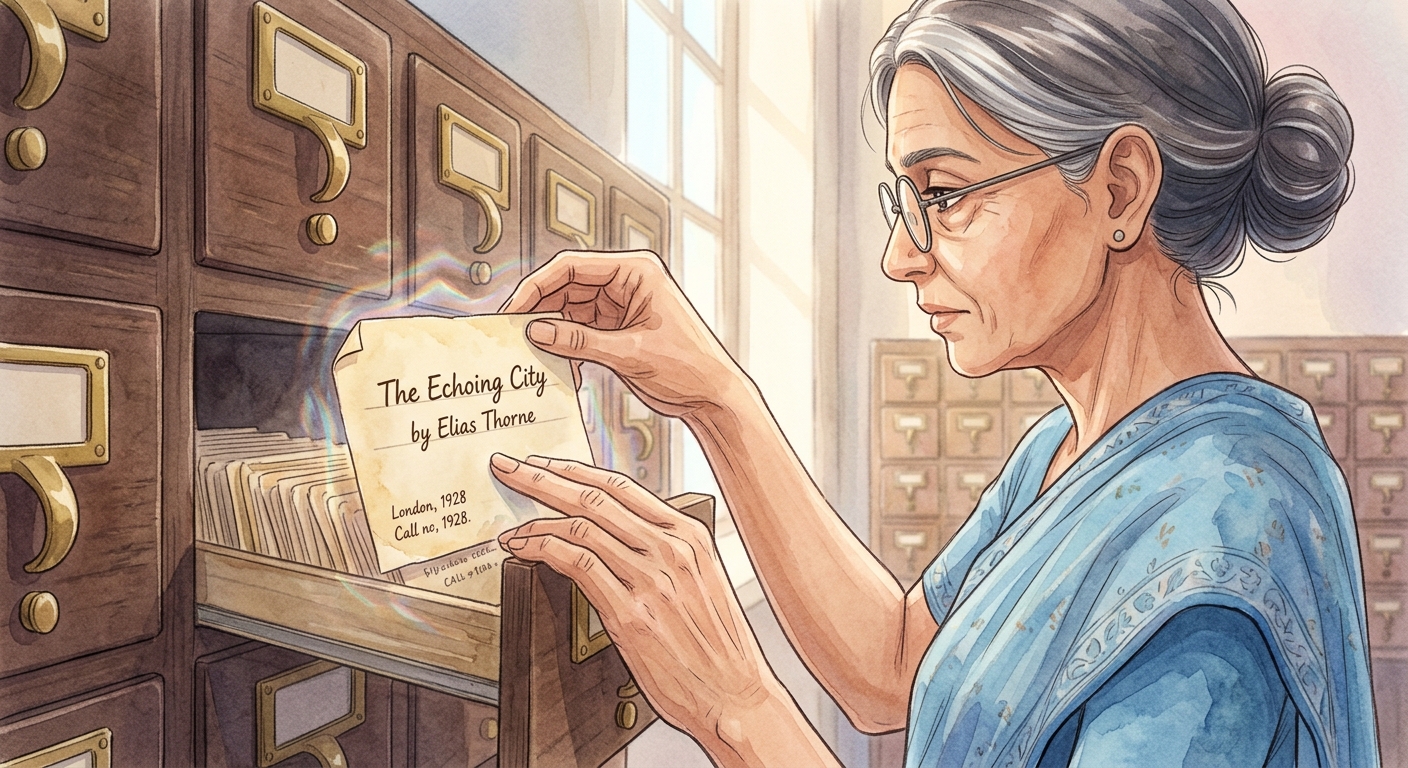
“Yes,” she confirmed, pulling it out. “Published 1947. You’ll find it in Section 11, Row B. But there’s a companion volume…” Jaya paused, her gaze lingering on the card, her brow furrowing almost imperceptibly. “A companion volume, or perhaps… a precursor. One not always listed in the public catalog.”
Rohan tilted his head, intrigued. “A precursor?”
Jaya didn’t meet his eyes immediately. Instead, she extracted another card, its aged parchment yellowed and brittle. “This one,” she said, her voice dropping to a near whisper. “It is QA-719.7. ‘The Whispering Walls: Unseen Vibrations of the Metropolis.’ Same author. No publication date listed. Only a faint, handwritten note in the margin: ‘Not yet.’”
Rohan leaned closer, trying to discern the faded script. “Not yet? What does that even mean?”
“It means,” Jaya explained, her fingers tracing the non-existent date, “that some books arrive here before they are truly written. Or perhaps, before their time has fully come. This library, Mr. Sharma, is not merely a collection of what is. It is also, at times, a repository of what will be, and what could have been.” She handed him both cards. “You are permitted to seek out QA-719.8. But I wonder… will you find QA-719.7?”
Rohan felt a prickle of unease, mingled with a profound sense of wonder. He’d come seeking academic data, not a lesson in temporal paradoxes. He nodded slowly, clutching the cards. He walked down the narrow aisle to Section 11, Row B, the fluorescent hum of the archives suddenly seeming louder, the dust-laden air thicker with unspoken secrets.
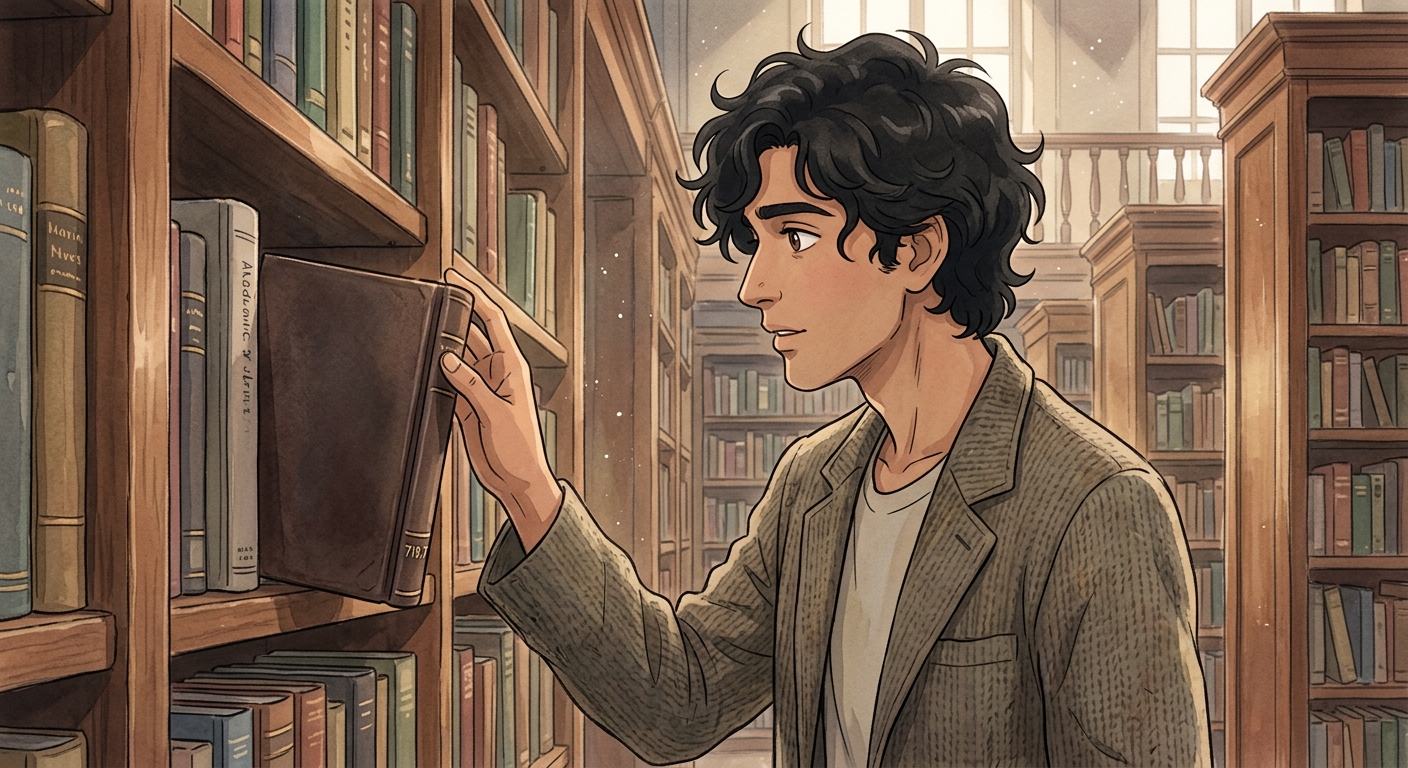
He found QA-719.8, a slim, academic volume, bound in unassuming grey cloth. But next to it, tucked slightly askew, was another book. Thicker. Bound in dark, almost black leather, unadorned by gold leaf or lacquer. Its spine was blank, save for a small, embossed number: 719.7. There was no title. No author. Nothing. Rohan pulled it out. The cover felt cool beneath his fingers, oddly smooth. He opened it. The pages were blank, perfectly white, yet somehow warm to the touch. He closed it, a faint scent of rain-soaked earth and old ink wafting from between its covers. He looked back towards Jaya Malar’s desk. She wasn’t watching him. Her head was bowed over the Cartographie des Mondes Impossibles, her fingers resting lightly on its fragile spine, a quiet, knowing smile playing on her lips. For a fleeting moment, Rohan felt the hum of the library shift, as if the entire building sighed a secret, ancient truth. He left with only one book, but a universe of possibilities now resonated within his own chronicon.
What did you think?
Reader Thoughts
No thoughts yet. Be the first to share yours.
Join the conversation
Log in or create a free account to share your thoughts on this story.