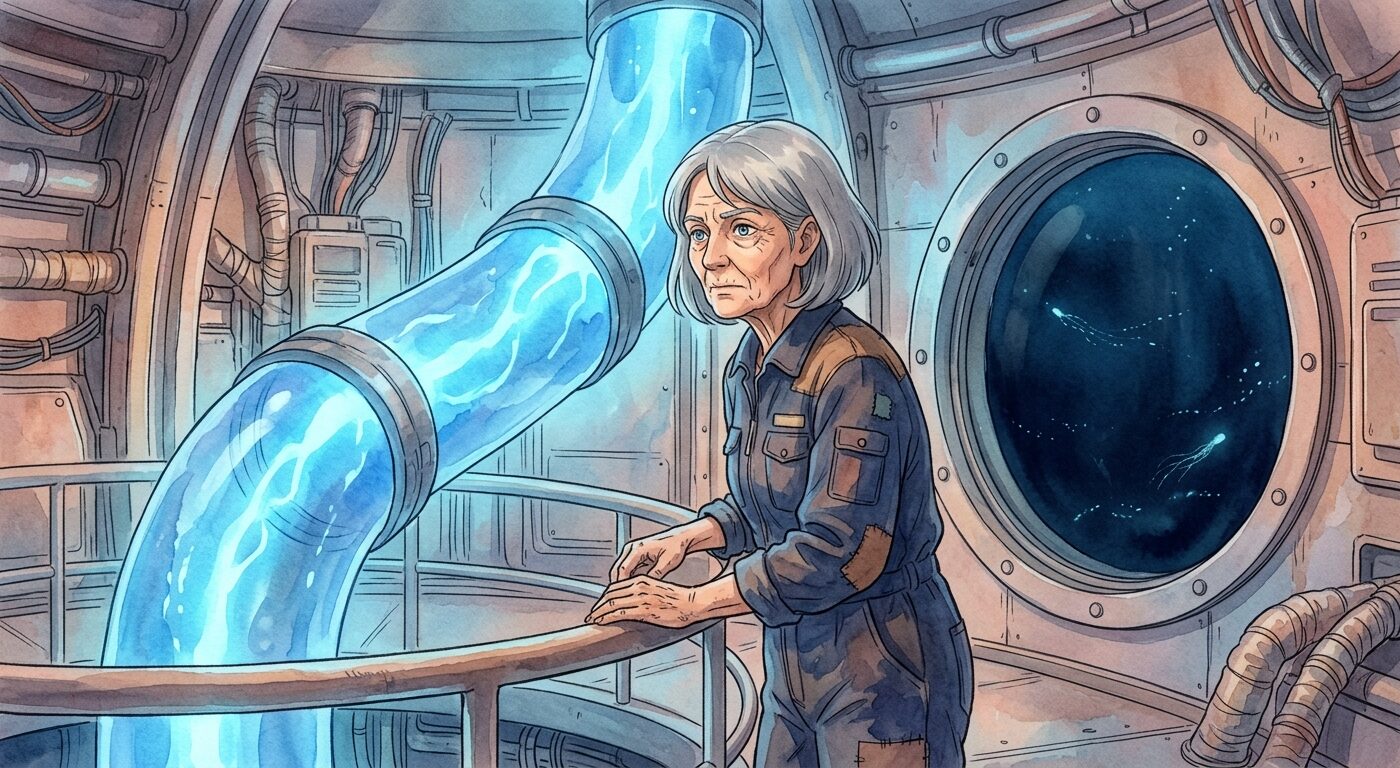
The hum of the conduit was Idra’s lullaby, a constant, low thrum against the thick metal hull of Station Echo-7, two miles beneath the surface. For seventy-three years, this station had served its initial purpose—deep-sea mineral extraction, environmental research, mapping abyssal currents. Now, it was just her and the hum, a single, vital nerve ending in a world that had forgotten its former network.
Idra Volkov, an elderly woman in her late 70s, with a weathered face etched by years of solitude, sharp blue eyes, a short bob of practical grey hair, and hands calloused from decades of maintenance work, ran a gloved hand along the pulsating ceramic casing of the primary relay. It was a ritual, one of many. Not for efficiency, but for communion. The conduit knew her touch, she was sure of it, a living entity that responded to her careful attention.
The abyssal plain outside the main viewport was a velvet canvas, unbroken save for the occasional, languid drift of a bioluminescent creature – a ghost lamp passing a sunken cathedral. The station lights cast a pale, emerald glow into the immediate vicinity, illuminating ancient sediment. Idra often wondered what those light-fearing fish thought of her, this solitary sentinel in their eternal night.
Her duties were simple now: monitor the frequency, check the pressure valves, recalibrate the secondary stabilisers twice a day. Each movement was deliberate, perfected over decades. She was part of the station, as much as the bolts and the reinforced titanium. Without her, the hum would falter. Without the hum, a fragile network of surface-world communication would collapse. Not important enough for a relief crew, but critical enough to keep one old woman quietly tethered to the deep.
Today, a tiny anomaly flickered on the tertiary display – a micro-fluctuation in the harmonic resonance. Barely perceptible, easily dismissed by automated systems. But Idra saw it, felt it. It was the equivalent of a sigh. She adjusted a dial, a quarter-turn, then another, feeling the faint feedback through the floor plates, a subtle shift in the station’s overall vibration. The fluctuation smoothed, the green line on the monitor a flat, contented pulse.
She took her usual seat, a worn chair bolted to the deck, and poured herself a mug of lukewarm synthetic tea. The silence, broken only by the conduit’s unwavering thrum, was not empty. It was full of her own thoughts, of the ocean’s weight, of the countless stories etched into the steel around her. Every rivet, every faded decal, whispered of past crews, of ambitious projects, of triumphs and eventual obsolescence.
But for Idra, there was no obsolescence. Her purpose remained. She had learned to distinguish the subtle nuances of the hum – a whisper of tension, a rumble of fatigue, a surge of quiet power. It was a language spoken only to her, understood only by her.
She sometimes dreamt of the surface, of sunlight on skin, of other voices. But the dreams faded quickly upon waking, replaced by the familiar comfort of the hum. The station was her world, her family. It didn’t ask for much, just her presence, her vigilant touch. And in return, it gave her everything: purpose, peace, a profound, resonant connection.
Idra closed her eyes, letting the vibrations seep into her bones. The hum was not just power; it was a heartbeat, slow and deep. A pulse not for the world above, but for her, a singular, steadfast conductor, two miles beneath the waves, guiding its song.

What did you think?
Reader Thoughts
No thoughts yet. Be the first to share yours.
Join the conversation
Log in or create a free account to share your thoughts on this story.