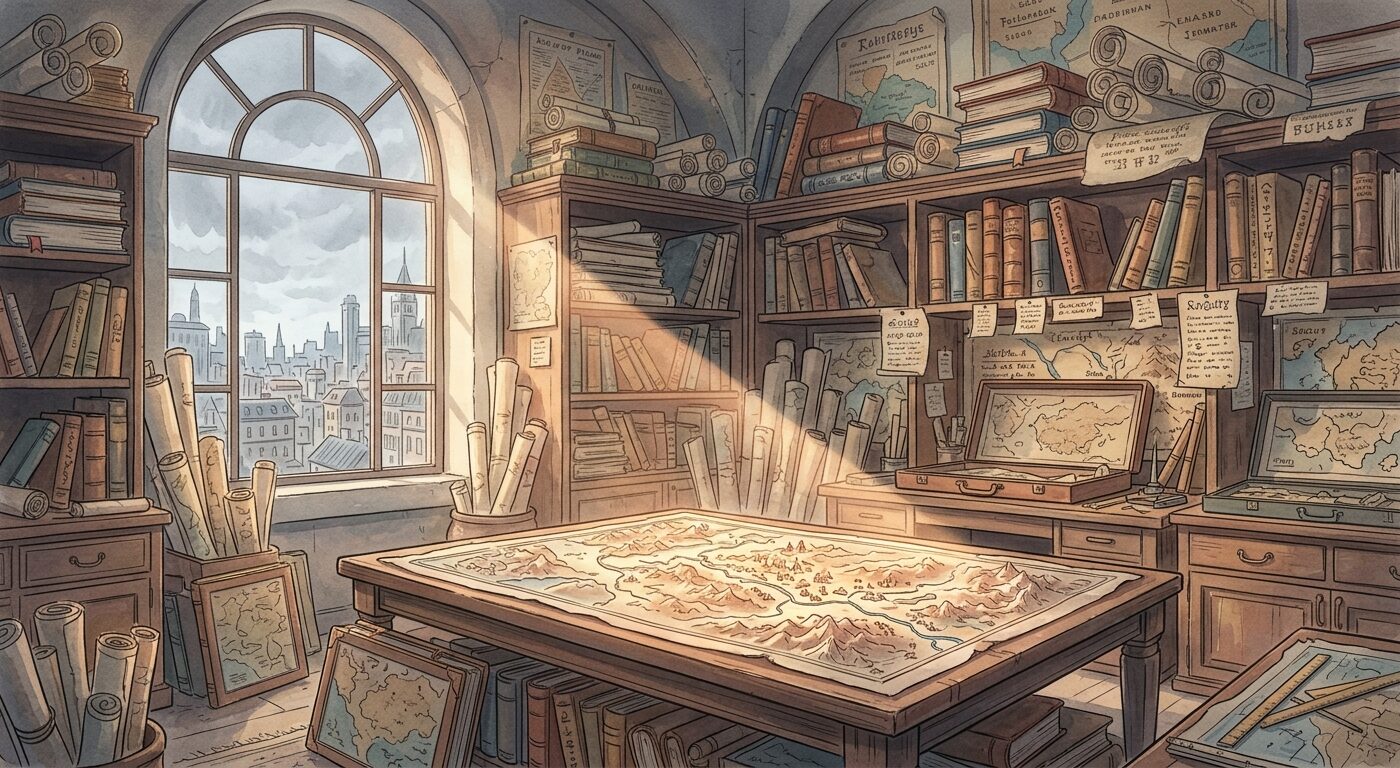
My shift in the Department of Ephemeral Geographies began, as always, with a quiet resignation to the absurdity of it all. The City, a vast, restless beast of concrete and glass, never paused for measurement. Every morning, the ‘official’ map on my desk, a sprawling, intricately embossed relief of what was, became a historical document before the first coffee cooled. My job, you see, was to update it, to meticulously record the new arteries, the vanished districts, the impossible angles of growth that defied Euclidean logic.
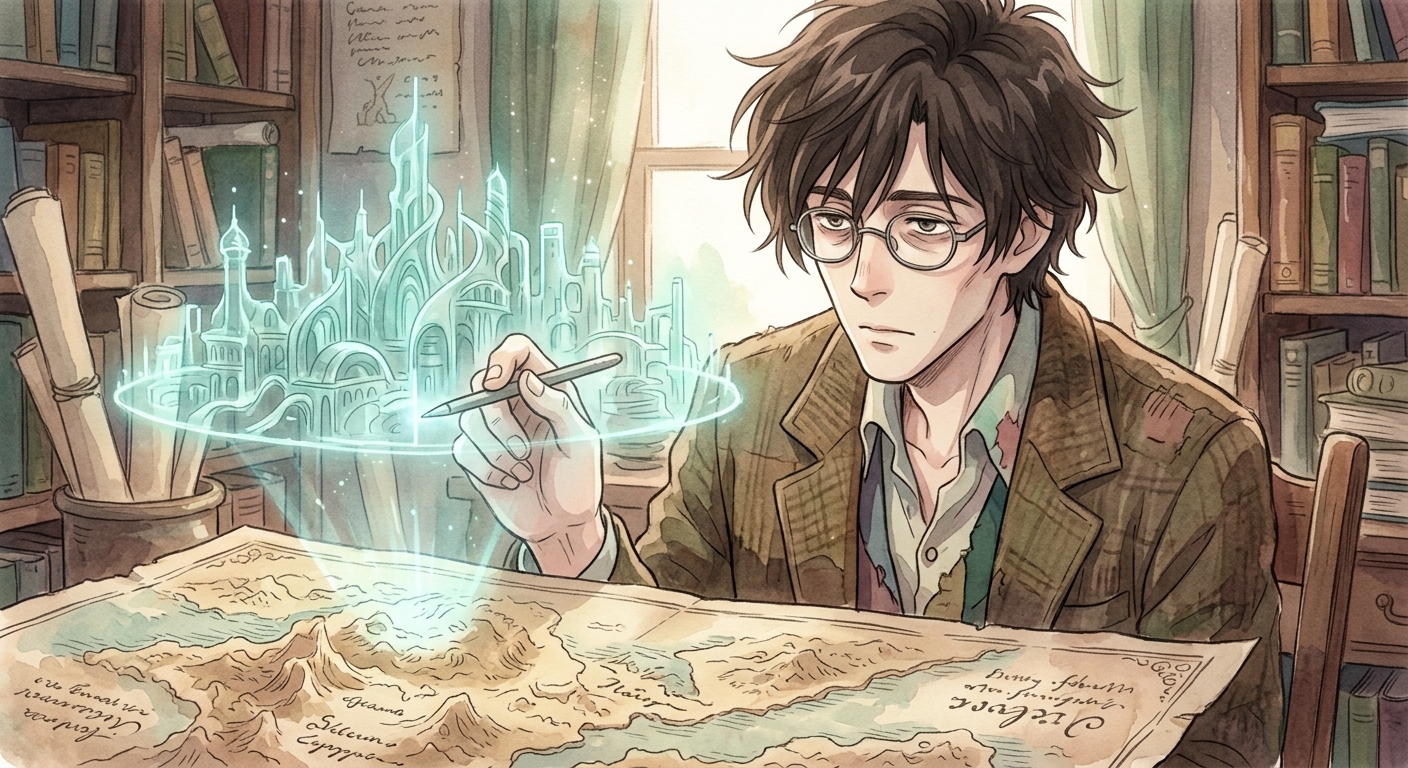
I traced the ghost of the Old Bazaar district, now a gaping crater where a new transit hub was meant to rise. The digital interface, humming beside the ancient, leather-bound atlases, showed real-time demolition dust. How many times had I drawn this particular stretch of street, only to erase it weeks later? It felt less like cartography and more like curating a gallery of urban ghosts.
Another one bites the dust, eh, Kaelen?
Zoya leaned in through the doorway, a stack of freshly printed demolition notices in her hand. She was the only other person left on this floor of the Central Municipal Archive, dedicated to the city’s self-erasure. Her voice, perpetually laced with a cheerful cynicism, was the only antidote to the paper-dry silence.
Another phantom limb. Soon, the city will be nothing but scar tissue and forgotten blueprints.
I muttered, not looking up.
Ah, the cartographer’s lament. You map it, it moves. You map the movement, it accelerates. Perhaps we should just map the idea of the city, save ourselves the ink.
She chuckled, a dry rustle like old parchment. I paused, the fine tip of my stylus hovering over a newly designated green space that I knew, with an archaeologist’s certainty, would be a luxury condominium by next fiscal.
The idea of the city. Is it an idea of growth, then? Or simply entropy?
Zoya shrugged, her stack of papers nearly obscuring her face.
Whatever it is, it keeps us employed. And you, my friend, have a particularly intimate view of its digestive process.
She tossed a new requisition onto my desk – an urgent amendment for the ‘District of Perennial Flux,’ a recent addition to the official lexicon, signifying areas where change was not merely constant, but designed.
The very notion was a satirical masterpiece. A district designed for flux. How does one map impermanence? I sighed, pushing away the outdated relief map and pulling up a blank digital canvas. This was a new kind of cartography, not of permanence, but of potentiality. I began to sketch, not buildings, but vectors; not streets, but probabilities.
Later that evening, after Zoya had locked up, the quiet hum of the servers became the city’s heartbeat. I stood before the largest, oldest map in the room – a sprawling, meticulously detailed relief of the city from almost a century ago. It depicted a place I barely recognized, a city of defined edges and predictable thoroughfares. But even then, if you looked closely, you could see the faint pencil marks under the ink, the ghost of a street that never fully manifested, the shadow of a park that became a factory.
The city had always been a palimpsest, I realized. Layers upon layers of intention and accident, each new iteration obscuring, but never entirely erasing, what came before. My job wasn’t to fight the chaos, but to chronicle its dance. To acknowledge that the true map wasn’t the static representation, but the act of mapping itself, the endless, futile, beautiful effort to understand something fundamentally unknowable.
The digital map on my screen pulsed, a nascent, abstract rendering of the District of Perennial Flux. It was a swirling nebula of possibilities, devoid of fixed points, yet somehow more honest than any rigid grid I’d ever drawn. It wouldn’t be ‘finished’ tomorrow, or the day after, or ever. And for the first time in a long time, the futility felt less like a burden and more like a strange, liberating truth. The city wasn’t just collapsing and rebuilding; it was breathing. And I, its humble chronicler, was finally learning to breathe with it.
What did you think?
Reader Thoughts
No thoughts yet. Be the first to share yours.
Join the conversation
Log in or create a free account to share your thoughts on this story.