Descent into Memory
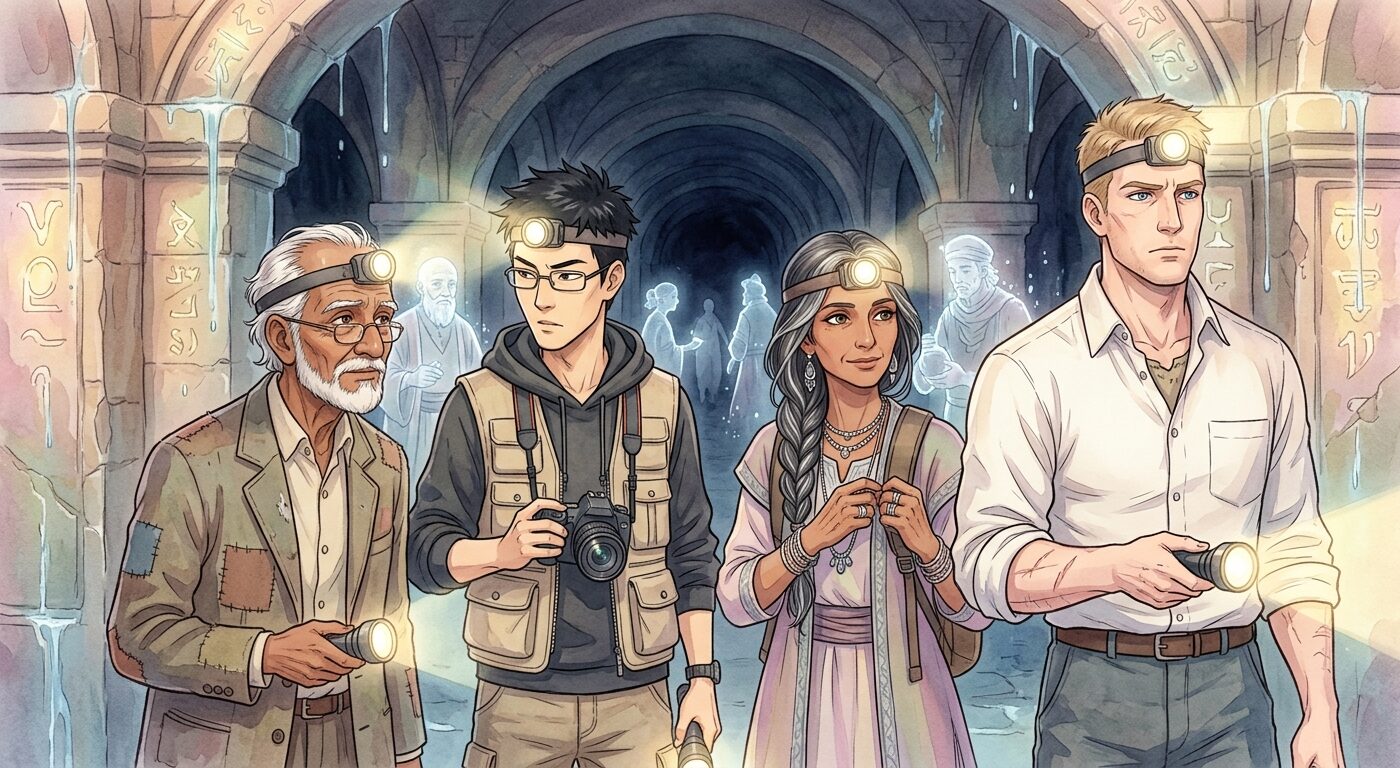
The air grew cooler, denser, as they descended into the forgotten underbelly of the Old Quarter. Ishmael, an elderly South Asian man in his late 70s with wispy white hair combed back, a neatly trimmed beard, and gentle, deep-set brown eyes. He wears a faded, patched tweed jacket and spectacles perched on his nose, led the way, his brass key now glowing with a soft, steady pulse, illuminating faint carvings on the damp stone walls. Behind him, Ren Chen, a lean East Asian man in his early 30s with short, spiky black hair, a sharp jawline, and perpetually skeptical eyes behind rimless glasses. He often sports a practical, multi-pocketed photographer’s vest over a dark hoodie, meticulously filmed everything, his skepticism replaced by a wide-eyed awe. Jaya Devi, a slender South Asian woman in her mid-40s with long, dark, braided hair streaked with silver, kind, observant eyes, and calloused hands. She prefers comfortable, layered tunic dresses and intricate silver jewelry, walked with a quiet reverence, her hand often reaching out as if to touch the shimmering phantoms that drifted past. Trailing somewhat awkwardly, Malachi ‘Mal’ Thorne, a broad-shouldered Caucasian man in his late 30s with close-cropped sandy blonde hair, a perpetually tired expression, and sharp blue eyes. He favors crisp, expensive work shirts, often with the sleeves rolled up, revealing faint construction scars, shone his high-powered flashlight, his pragmatic mind struggling to reconcile this impossible reality with his engineering principles.
This was the Subterranean Labyrinth, a vast network of ancient cisterns, forgotten merchant tunnels, and what appeared to be an entire underground market, predating even the oldest archival records. Ishmael had deciphered fragmented maps from various sources, stitching together clues that pointed to this nexus. Here, the ‘echoes’ weren’t faint whispers; they were a vibrant, swirling tapestry of life. Transparent figures haggled over phantom goods, children’s laughter echoed from unseen corners, and the ghostly scent of spices, hot bread, and canal water filled the air. This was the living heart of the Old Quarter’s memory, pulsating with millennia of human experience.
“It’s… more than just a historical site,” Ren breathed, his voice hushed, his camera barely able to capture the ethereal details.
The Erasure’s Advance
But a cold, grey tide was advancing. Deeper into the labyrinth, they encountered sections where the echoes were mute, faded to a ghostly whiteness. The vibrant colors of memory were bleached out, the phantom sounds replaced by a deafening silence. Mal’s construction project above ground, with its deep pilings and sonic vibrations, was sending ripples of erasure downwards, systematically silencing this ancient network. The glowing patterns on the cracked concrete, he now realized, were distress signals from the city’s very soul.
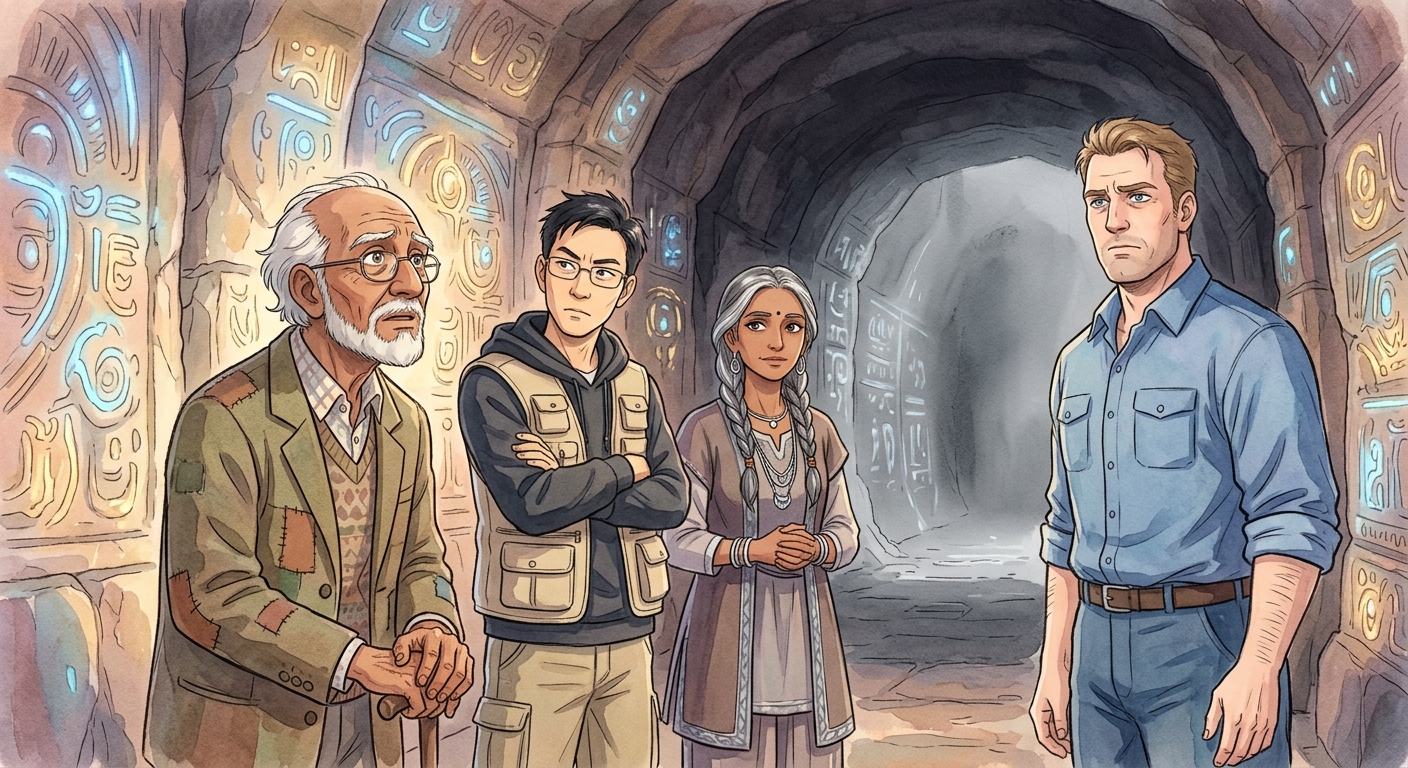
Jaya felt a sharp pang as they passed a section where a ghostly weaver, mid-stitch, dissolved into nothingness. “They’re not just memories,” she whispered, her voice thick with sorrow. “They’re… lives. Fading.” Ishmael nodded gravely, clutching the brass key tighter. This wasn’t an archaeological dig; it was an emergency rescue. Mal, observing the distress on their faces, the undeniable evidence of the fading echoes, felt a growing horror. His project, designed to create a better future, was committing an unforgivable act of cultural genocide, literally wiping out the past.
“I have to stop it,” Mal said, his voice firm, no longer betraying any doubt. “Even if it costs me everything.”
Harmonizing the Threads
They reached the deepest chamber, a vast, circular space supported by a massive, central pillar. Here, the echoes converged, shimmering with intense, vibrant energy – the nexus of the Old Quarter’s memory. But even here, the grey tide was encroaching, threatening to engulf the core. Ishmael held up the brass key, its glow intensifying, attempting to stabilize the weakening field. Jaya, guided by intuition, began to hum, a low, resonant melody that seemed to soothe the agitated echoes, her hands moving as if weaving an invisible fabric in the air.
Ren, ever the documentarian, found himself positioning his camera not to just record the spectacle, but to capture the subtle vibrations, the unseen frequencies, convinced that the answers lay not just in what was visible, but in the energies themselves. Mal, the engineer, surprisingly, began to analyze the sonic vibrations from above, using his knowledge to identify the exact frequencies causing the erasure. He realized that outright stopping the construction was impossible, but perhaps they could *redirect* the destructive energies, find a way to harmonize the modern city’s hum with the ancient pulse of the Old Quarter. He envisioned a sonic dampener, an architectural intervention that could protect the nexus.
The four, once strangers, now worked as a single, intuitive unit, each contributing their unique perspective. Ishmael provided the wisdom of the past, Jaya the intuitive connection to the present life of the echoes, Ren the objective (now subjective) observation, and Mal the pragmatic solution for the future. The nexus pulsed, flickering between vibrant memory and encroaching grey. They knew what they had to do. They couldn’t simply preserve the past in amber; they had to integrate it, allow it to breathe within the evolving future. The city wasn’t meant to be silent; it was meant to remember itself, and they were its unlikely, desperate champions.





What did you think?
Reader Thoughts
No thoughts yet. Be the first to share yours.
Join the conversation
Log in or create a free account to share your thoughts on this story.