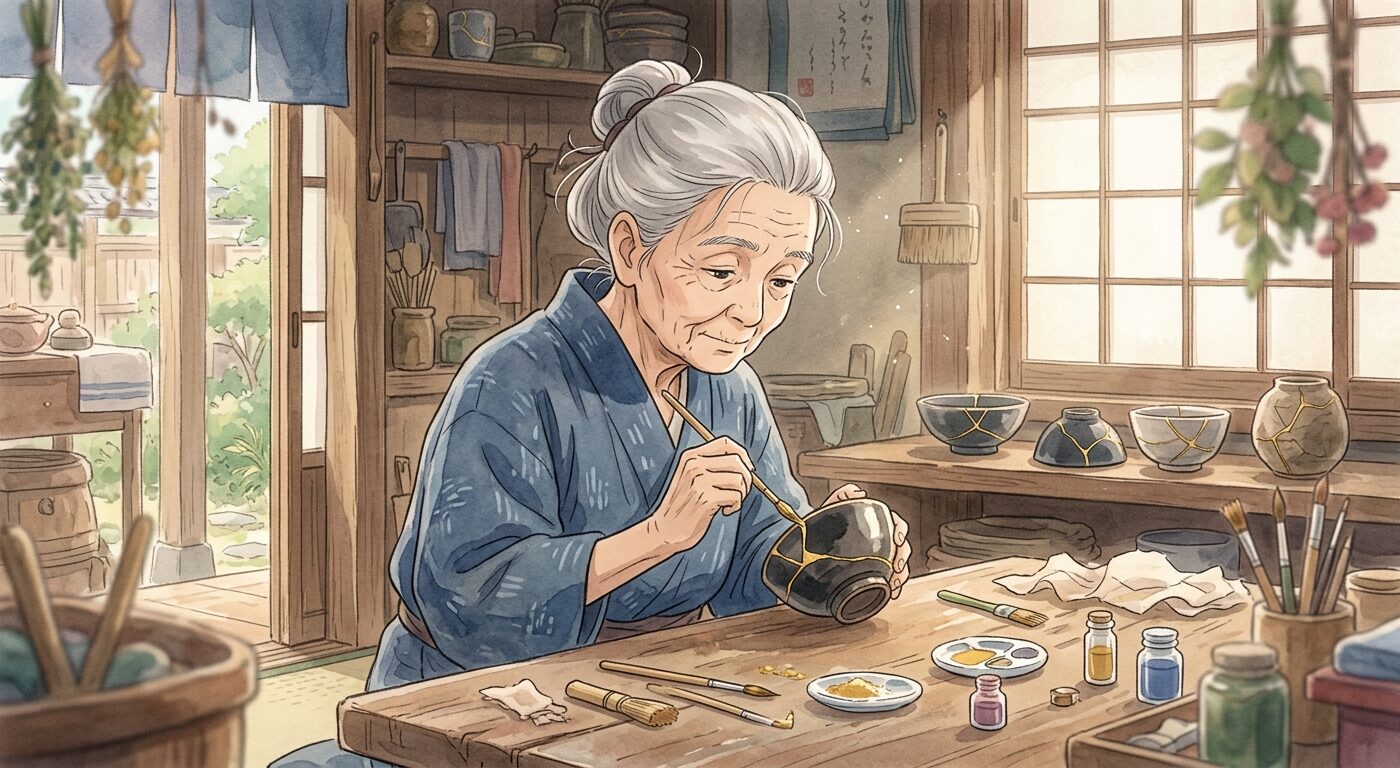
The bowl on the workbench was a universe of shattered fragments, each patiently awaiting its rebirth under Kiyomi’s steady hands. She picked up a sliver, smooth and cool, tracing the jagged edge with a fingertip. This piece, a particularly intricate celadon tea bowl, had arrived last week, its fractures radiating from a central impact point like frozen lightning. It was a challenge, exactly the kind that sharpened her focus, pulling her entirely into the present moment of repair.
Her workshop, nestled behind the bustling market in the old city quarter, always smelled faintly of camphor, pine, and the rich, earthy tang of urushi lacquer. Sunlight, filtered through the paper screens, laid stripes across the worn tatami mats and the shelves laden with mended treasures – a ceramic rabbit with a silver ear, a sake cup crisscrossed with veins of gold, a tiny, almost invisible mend on the lip of a rice bowl. Each piece told a story, not of perfection, but of resilience, of being put back together, often more beautiful than before.
Kiyomi dipped her finest brush into the tiny pot of lacquer, mixed with a hint of gold dust. Her hands, gnarled with seventy-odd years of meticulous work, were still steady, betraying none of the tremors that sometimes seized her mind. Lately, the edges of her own memories felt as sharp and disjointed as these ceramic fragments. Names would float just beyond her reach, faces would shimmer like heat haze, entire afternoons vanish into the humid air.
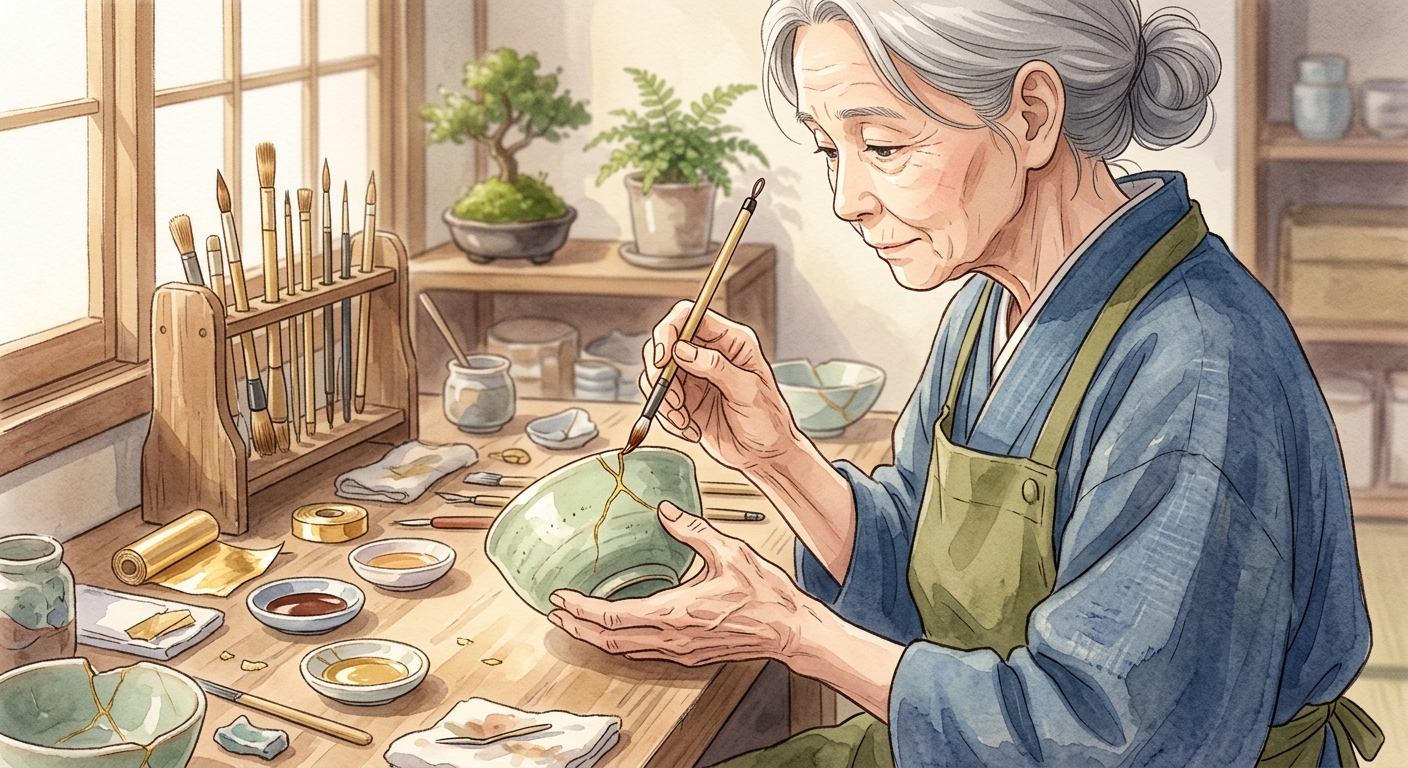
She began applying the gold-laced lacquer to one of the longer cracks. It flowed like liquid light, filling the wound, transforming the break into a deliberate, shimmering line. This was the philosophy of kintsugi: embrace the damage, celebrate the history. But what of a history that splintered and reformed on its own, beyond her control? Sometimes, a scent or a texture would unlatch a fragment, sharp and clear. Then, just as quickly, the image would shatter again, leaving her with the ghostly echo of emotion, but no narrative.
She remembered the owner of this bowl – a young man, earnest, with eyes that held a hint of his grandmother’s, a regular client. He’d entrusted her with several pieces, always with a solemn reverence for the objects. But a particular shade of blue he’d mentioned, a specific story behind the tea bowl’s origin, now eluded her. The memory of his request was there, but the details, the specific shades that gave it meaning, were like smoke.
The silence of the workshop was a balm. The rhythmic scrape of a sandpaper block in the corner, where her apprentice Kenji meticulously prepped another piece, was the only sound. He was young, patient, still learning the delicate art, not just of repair, but of seeing the inherent beauty in the brokenness. He saw the fragments; Kiyomi saw the completed whole, even before the lacquer dried. Or at least, she used to.
A thought, fragile as an eggshell, presented itself. She had seen this bowl before. Not one like it, but *this* bowl. The pattern of the breaks, the tiny chipped rim near the base, the way the light caught the pale celadon glaze – it was all too familiar. But when? Had she already mended it once? Her mind, a quiet storm of dust and fog, offered no clear answer. It felt like trying to grasp water.
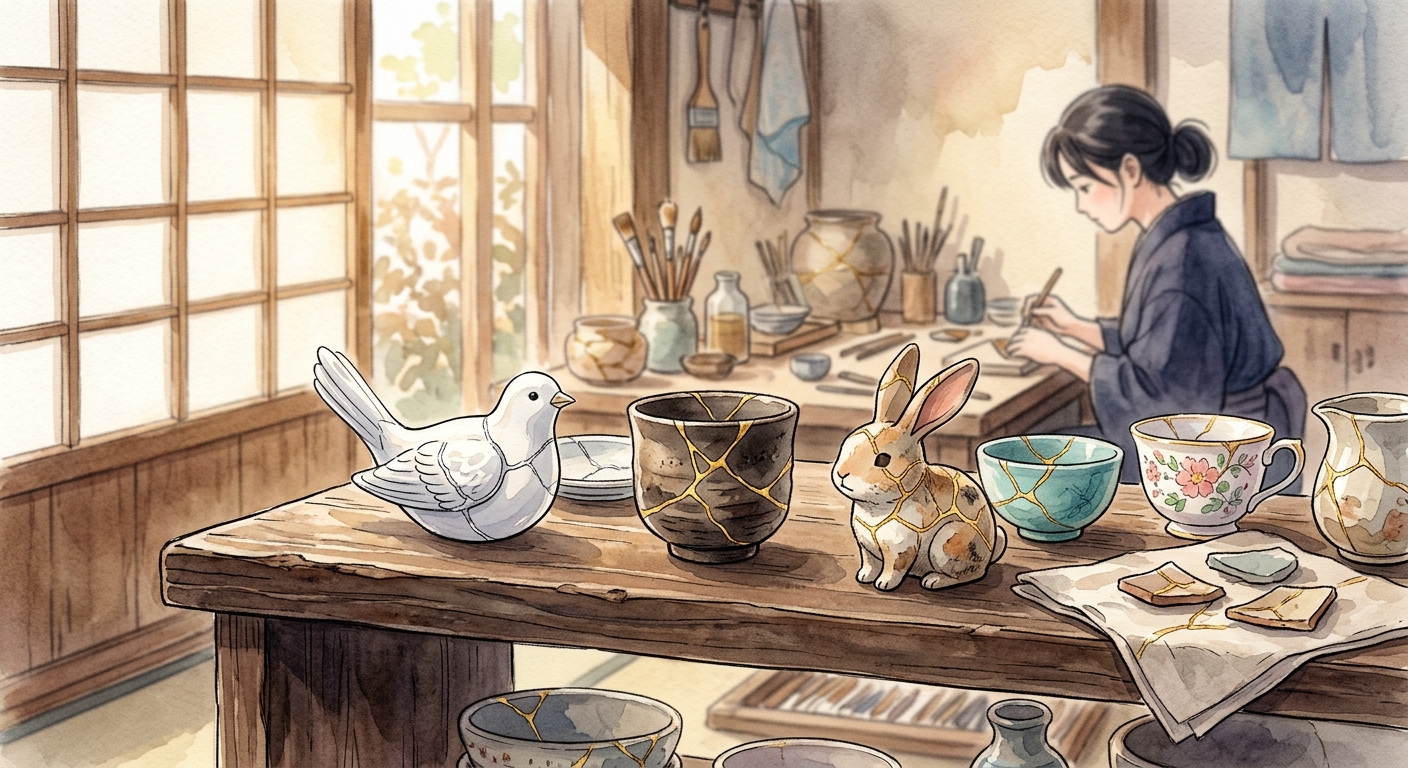
She continued her work, the methodical nature of the kintsugi a anchors to her drifting mind. Joining one fragment to another, using the precise amount of gold-flecked urushi, feeling the weight of the clay in her palm. The process was almost meditative. Each seam was a prayer, a testament to endurance. The cracks were not flaws to be hidden, but a history to be honored, etched in gleaming gold.
Her gaze drifted to the shelves, to the parade of mended artifacts. Each told a partial tale. A small porcelain bird with a reconstructed wing. A ceramic flute with a golden ligature. They were not perfect, but their imperfections were their strength, their stories. Kiyomi remembered a mendicant once telling her that the gods smiled upon those who found beauty in the cracks, for that was where the light truly entered.
She finished the last major fracture, stepping back to admire her work. The celadon bowl, once desolate, now pulsed with a new life, its golden veins like the viscera of a delicate creature. It was a cartography of its own suffering, transformed. The young man would be pleased.
A faint tremor ran through her hands, not of age, but of recognition. A ghost of a memory, suddenly vivid. The young man, yes, and his grandmother. They had brought the bowl to her years ago, the first time it had broken. She had mended it then, too. The young man’s earnest eyes, the same reverence. Kiyomi placed the bowl gently on a velvet cloth to cure, the gold shimmering in the filtered light. Her own memory, fractured and mended, now held a new, fragile seam. A seam she had known, mended once before.
What did you think?
Reader Thoughts
No thoughts yet. Be the first to share yours.
Join the conversation
Log in or create a free account to share your thoughts on this story.