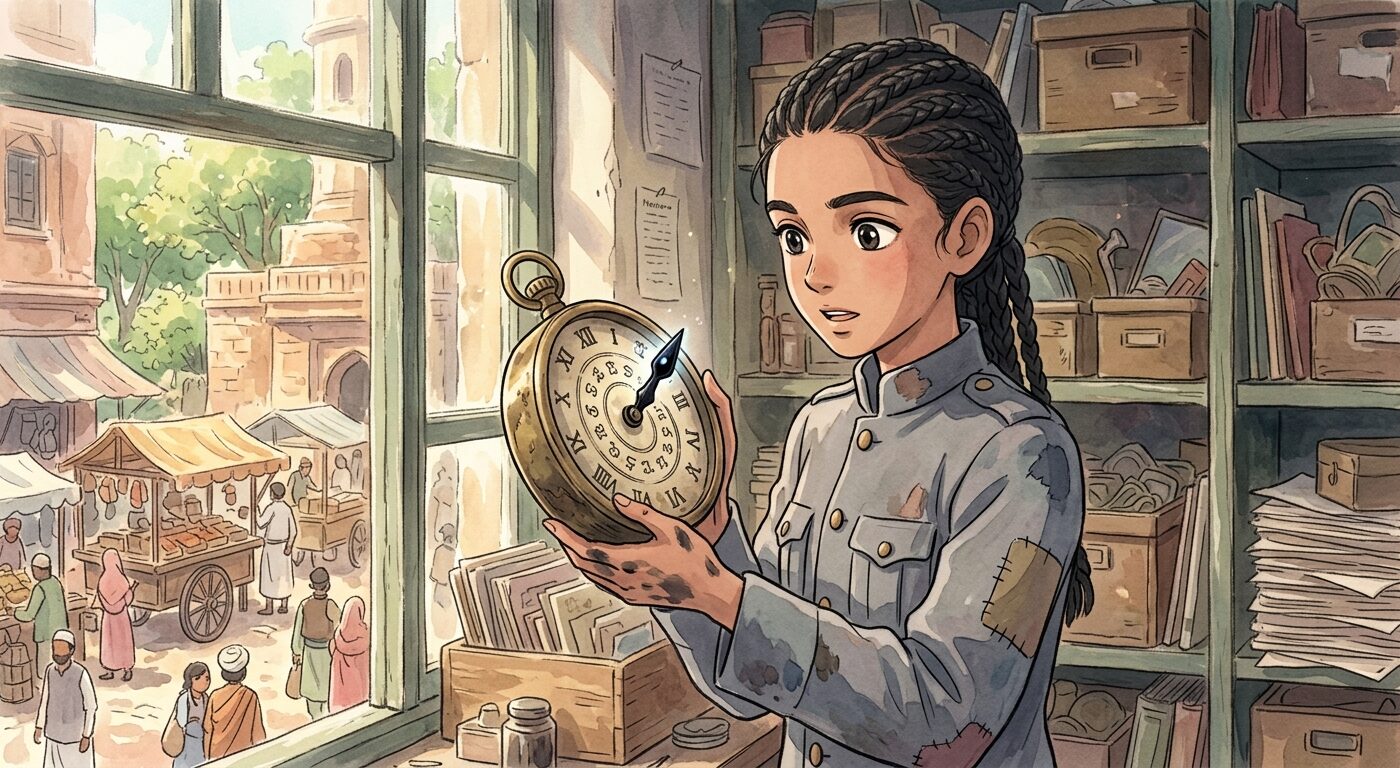
The Municipal Department of Lost Properties, in a city that itself felt largely misplaced, was where Ria spent her days categorizing the world’s quiet discards. A slender young woman in her late teens, of South Asian descent, with dark, tightly braided hair, large watchful eyes, and hands stained faintly with ink, wearing a patched, grey municipal uniform with a high collar, she was an expert in the forgotten: a single glove, a half-chewed pencil, an umbrella with a broken rib. Her station, a precarious stack of ledgers on a wobbly desk, sat by a grimy window overlooking a market lane, its chaotic symphony a constant counterpoint to the office’s hushed dust.
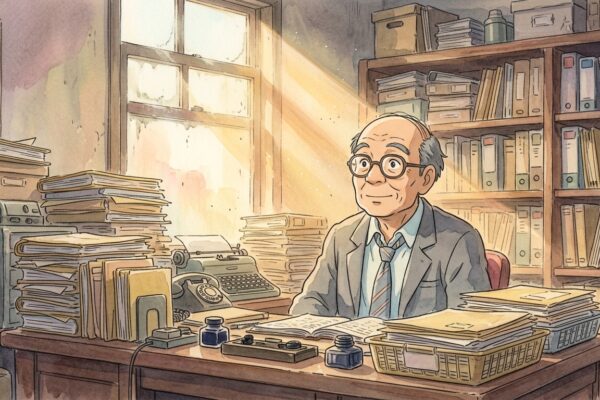
Supervisor Jayan, a corpulent man in his late 40s, of South Asian descent, with thinning grey hair slicked back, a perpetually stained white vest under his open municipal jacket, and a drooping mustache, often seen with eyes half-closed, snored gently at his own desk, a formidable mountain of unopened mail. His job was to approve Ria’s fastidious entries; his reality was a series of naps punctuated by tea breaks.
One sweltering afternoon, a new crate arrived. Most contents were predictable: a wooden doll with one eye, a dented tin whistle, a faded silk scarf. But at the bottom, nestled amongst a tangle of defunct keys, lay a clock unlike any Ria had ever seen. It was palm-sized, made of tarnished brass, with intricate gears visible beneath a glass dome. Its face had no conventional numbers, only a spiral of tiny, illegible symbols. Stranger still, it ticked not with the steady rhythm of a timepiece, but with an erratic, almost gasping beat – tick-tock… tock-tick-tick… pause… tock. One of its two hands, thin as a spider’s leg, was missing. The other, tipped with a minute, obsidian bead, pulsed faintly with a dull, inner light.
Ria picked it up, feeling a strange thrum against her palm. It wasn’t heavy, but felt dense with un-time. She turned it over, seeking a manufacturer’s mark, a clue. There was none, only a small, almost invisible inscription beneath the missing hand’s pivot: “To mend the pause.“
She tried to show Jayan. “Sir? This one is… peculiar.”
He grunted, swatting vaguely in her direction. “If it ticks, it tells time. Enter it as ‘Timepiece, malfunctioning’. Next.”
Ria sighed. She knew better than to argue. But this wasn’t malfunctioning; it was operating on a different set of rules entirely. The clock, an anachronistic whisper in a world of loud discards, sat on her desk, ignored by Jayan, but studied intently by Ria. She noticed patterns in its erratic ticking: a short burst always preceded a particularly noisy argument in the market below, a slow, drawn-out beat when the afternoon sun fell precisely on the window sill. The obsidian bead of its single hand seemed to move in imperceptible increments, pointing to different symbols on the spiral, not tracking the sun or the moon, but something else entirely. Something in the city’s hidden pulse, an unfathomable vernacular of time and space.
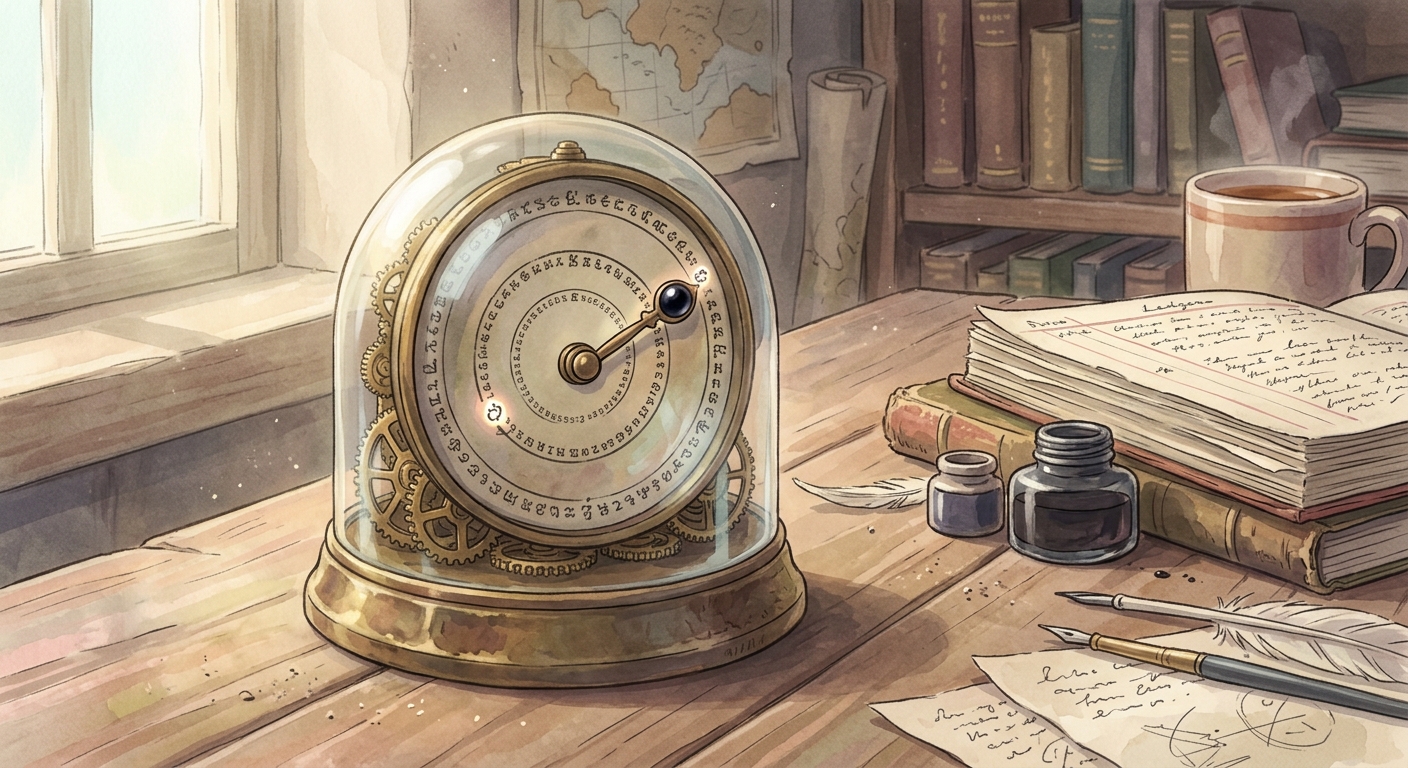
Weeks later, Ria arrived one morning to find the bead glowing brighter than usual, pointing directly at a symbol resembling a closed eye. The office felt heavy, strangely still. Jayan was already there, unusually awake, staring at a stack of freshly arrived items. Among them, a miniature brass telescope, precisely the size of the clock’s missing hand. It too, hummed with a faint energy.
Ria’s breath hitched. This was no coincidence. She looked from the clock, to the telescope, to the inscription: “To mend the pause.” The office, the city, her own endless routine – they were all waiting for something. And perhaps, the clock wasn’t just measuring the pauses in the world, but the pauses *before* something began. She gently picked up the telescope. It fit perfectly into the empty slot on the clock’s face. The moment it clicked into place, the room shimmered, and the city outside fell utterly silent, holding its breath. The clock’s erratic rhythm smoothed into a steady, resonant beat, and both hands began to spin, faster and faster, pointing to symbols that began to glow, one after another, like stars igniting on a newly discovered map.


What did you think?
Reader Thoughts
No thoughts yet. Be the first to share yours.
Join the conversation
Log in or create a free account to share your thoughts on this story.