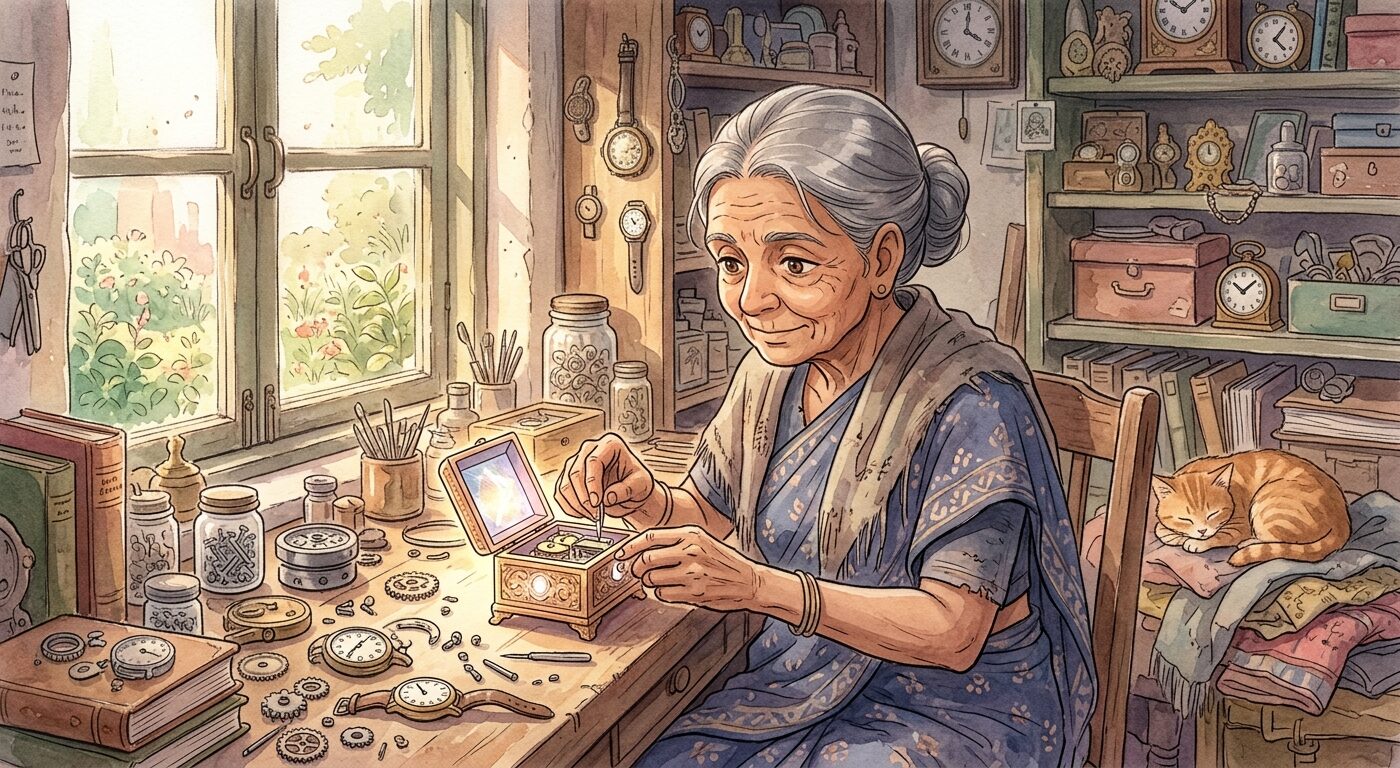
Saroja Devi understood the language of silence better than words, especially the brittle silence that settled over things once they broke. Her tiny shop, tucked down a narrow, nameless alley off the main market, was a sanctuary of such silences: the hush of a stopped grandfather clock, the choked breath of a music box whose spring had snapped, the muted lament of a porcelain doll with a missing eye. Dust motes, thick as tiny spirits, danced in the single shaft of sunlight that pierced the gloom, illuminating shelves overflowing with broken dreams in brass, wood, and glass.
The market outside, a riot of spices and insistent hawkers, rarely intruded. But today, the bell above the door jangled with uncharacteristic aggression, announcing Kiran Das. He was a young man, barely out of his teens, with the quick, restless energy of someone always chasing the next rupee. He usually brought her simple things – a watch needing a new battery, a figurine with a chipped base. Today, he clutched a small, intricately carved music box, its dark wood covered in patches of faint verdigris, a unique starburst pattern intaglioed on its lid.
“Old woman,” Kiran began, his voice a little too loud for the small space, “this one’s special. Found it in a forgotten crate at the old collector’s estate sale. It doesn’t play, but it feels… heavy.” He set it on her workbench, the polished wood gleaming faintly, even through the grime.
Saroja picked it up. It hummed in her palm, not with mechanics, but with memory. A faint smell of jasmine and old paper clung to it. She closed her eyes. It spoke of a young couple, whispered vows under a twilight sky, laughter that turned into quiet tears. It spoke of waiting, a lifetime of it, for a melody that never fully arrived.
“It’s very broken, Kiran. More than just a spring.”
Kiran shrugged, a curious tilt to his head. “Can you fix it? A quick turn-around, if you please. It’s for a good price, if it works.”
Saroja didn’t promise. She simply nodded, her fingers already tracing the faint, almost invisible lines of the starburst. She felt its longing, a deep, quiet ache that resonated with something ancient in the city’s foundations. This wasn’t about gears and cogs; it was about disentangling a knot of time.
Days later, Kiran returned. The market’s cacophony seemed to fade as he stepped into the quiet shop. The music box sat on Saroja’s workbench, now clean, its intaglio shining. Saroja turned the tiny key. A hesitant, almost mournful note drifted into the air. Then another, clearer, brighter. The melody unfolded, a haunting, unfamiliar lullaby that pulsed with a slow, tender rhythm. It was the same melody Saroja had felt in her hands, now given voice.
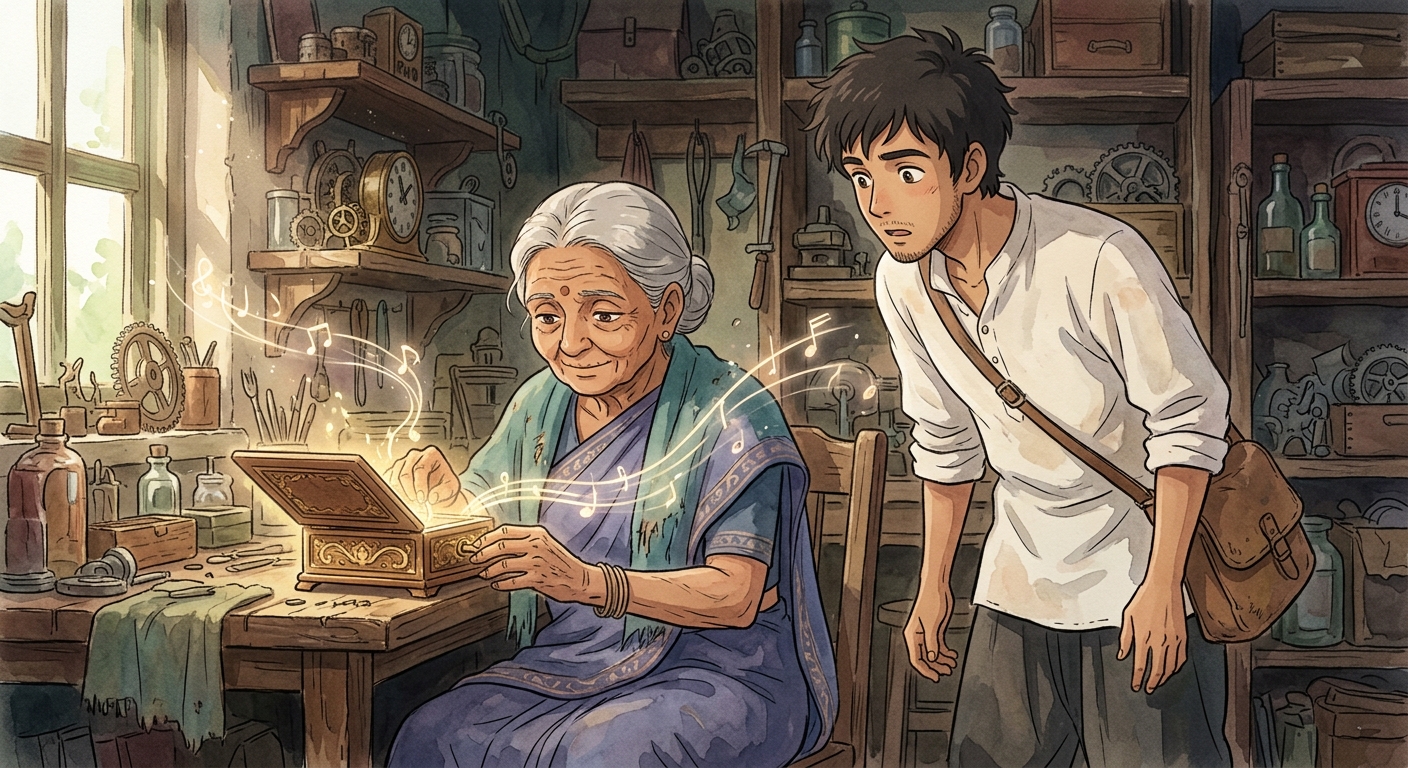
Kiran’s jaw dropped. He had never heard anything like it from one of Saroja’s repairs. The intricate tune filled the small shop, seeming to push back the dust and gloom, to breathe life into the silent, waiting objects on the shelves.
“What is it?” he breathed, leaning closer. “It’s… I’ve never heard this tune.”
“The melody of a long wait,” Saroja murmured, her gaze distant, fixed on something beyond the dusty window. “Of a love kept in silence. Of a tiny shift in the world, once it is remembered.”
Kiran stood, mesmerized by the music, a rare quietness settling over his usually restless form. He pulled out the exact payment Saroja requested, no haggling, no complaints. He picked up the box, cradling it gently. He didn’t understand the story, not fully, but he felt its resonance. As he left, the music box still played its tender lament, trailing behind him like a quiet promise into the garrulous chaos of the market. Saroja smiled, a bittersweet line on her face. Another broken thing made whole, its song released, its story now a part of the city’s endless, whispering heart.
What did you think?
Reader Thoughts
No thoughts yet. Be the first to share yours.
Join the conversation
Log in or create a free account to share your thoughts on this story.