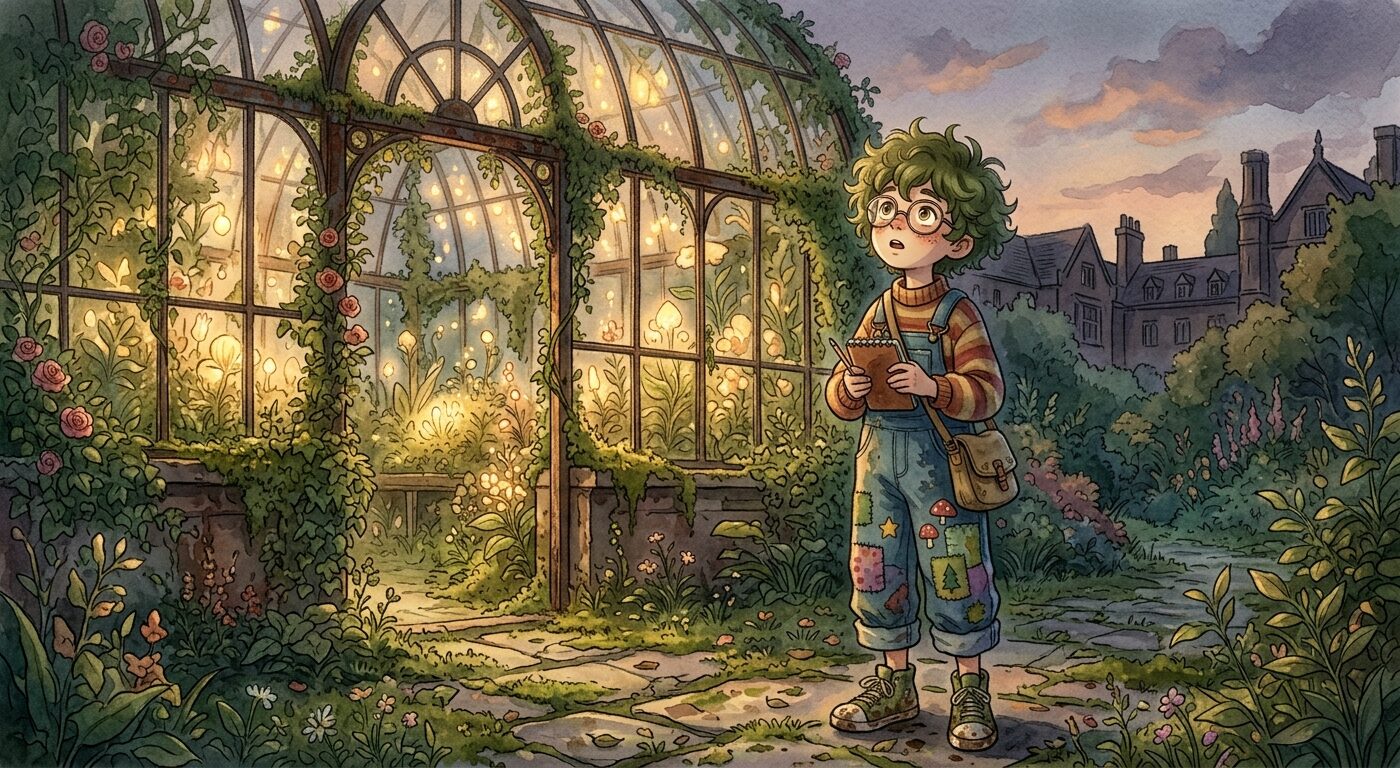
The old university greenhouse, tucked behind the abandoned physics lab, didn’t just grow plants; it remembered. I knew this because I, Pip, the self-appointed Root Keeper, could feel it. Each rustle of a leaf, each slow unfurling of a new bud, wasn’t just photosynthesis; it was a sigh, a secret, a fragment of something ancient that the plant had absorbed from the earth, the sun, or even the air. The outside world saw only shattered glass and overgrown weeds clinging to the crumbling brick balustrade, but I saw a living archive.
My days were spent navigating the labyrinthine paths between towering ferns and flowering vines, tracing the lines of pollen on my fingers, listening. The giant Corpse Flower, thankfully dormant, always hummed a deep, melancholic tune of forgotten empires, while the delicate orchids whispered of fleeting loves and distant rains. My grandmother always said I was ‘too quiet,’ ‘always in my head,’ but my head felt like the greenhouse itself: filled with verdant thoughts and silent stories.
One Tuesday, a strange warmth prickled my fingers as I ran them over the dusty soil near the Old Tree, a gnarled oak that had somehow grown through the greenhouse’s roof, acting as a natural sentinel. Buried shallowly was a seed, unlike anything I’d ever seen. It wasn’t brown or speckled, but smooth and almost iridescent, a deep, oily purple that seemed to drink the light. A faint, almost imperceptible hum resonated from it, a tiny song of longing.
I carefully unearthed it, wiping away the dark earth. It felt heavy, not with density, but with unspoken potential. This wasn’t just a seed; it was a dormant story, waiting. I knew, without being told, that it had traveled far, perhaps from a time before the university, before the city, before even the Old Tree. It felt… hungry for attention, not for nutrients alone, but for a listener.
I prepared a special pot, mixing rich soil from the base of the ginkgo tree – the most garrulous tree in the greenhouse, full of bright, ephemeral childhood memories – with fine river sand. I nestled the shimmering seed in its new bed, then watered it with a gentle trickle from my cracked ceramic watering can, the one shaped like a toad. I sat beside it, criss-cross applesauce on the damp floor, and simply watched.
Hours passed. The sun shifted through the grimy glass, painting stripes of amber and emerald across the floor. The greenhouse hummed its usual symphony of rustles and sighs, but now, beneath it, was the new, steady pulse of the seed. It hadn’t sprouted. It hadn’t even cracked open. But the light from it was growing, a soft, internal nebula of deep violet, pushing against its shell.
I remembered the Professor’s dusty notes, found tucked beneath a forgotten microscope, talking about ‘resonant frequencies’ of certain exotic species. Maybe this seed didn’t need water or sun, not in the way other plants did. Maybe it needed a story to hear, a memory to resonate with. I closed my eyes and reached out with my quietest thoughts, letting the memories of the ginkgo, the orchids, even the gruff Corpse Flower, flow towards the seed.
It worked. Slowly, like the breath catching in a sleeping child, the purple light intensified, rippling. The hum grew, a resonant chord that vibrated through the floor and up my spine. The shell of the seed began to crack, not with force, but with an elegant, almost musical precision.
From the fissure emerged not a sprout, but a single, tightly furled petal, glowing with an internal effulgent light. It was the color of a sunset captured in deep water, and it unfolded with glacial slowness, like a secret finally shared. Another petal emerged, and another, each one carrying intricate patterns like frost on a windowpane, or the veins on an ancient map.
The bloom was an anemone of light, a star fallen onto my damp soil. Its fragrance was subtle, not floral, but like ozone after a summer storm, mixed with the faintest scent of old paper and forgotten tea. And within its core, a tiny, vibrant image began to form: a fleeting snapshot of a laughing face, a weathered hand holding a shimmering stone, a winding river disappearing into mist.
It was the seed’s memory, blossoming. Not just a memory of a time, but of an emotion, a fragment of a life lived. I knelt, my face close enough to feel the warmth, my breath held. The entire greenhouse seemed to fall silent, every leaf listening, every root stretching towards this new, radiant story.
“Welcome home,” I whispered, my voice barely a breath against the glowing petals. My fingers brushed the vibrant light, and for a moment, I felt the memory of the laughing face, bright and clear as if it were my own. The greenhouse had another story, and I, its Root Keeper, was honored to hold it.
As the sun finally dipped, painting the outside world in the muted grey of evening, the bloom pulsed, a steady beat of light. The other plants, as if rejuvenated, seemed to hum louder, their own stories feeling less solitary now. I knew my work wasn’t just about watering and pruning. It was about listening, about tending to the world’s quiet, green heart, one forgotten memory at a time. And as long as there were stories to remember, the greenhouse would never truly be abandoned.
What did you think?
Reader Thoughts
No thoughts yet. Be the first to share yours.
Join the conversation
Log in or create a free account to share your thoughts on this story.