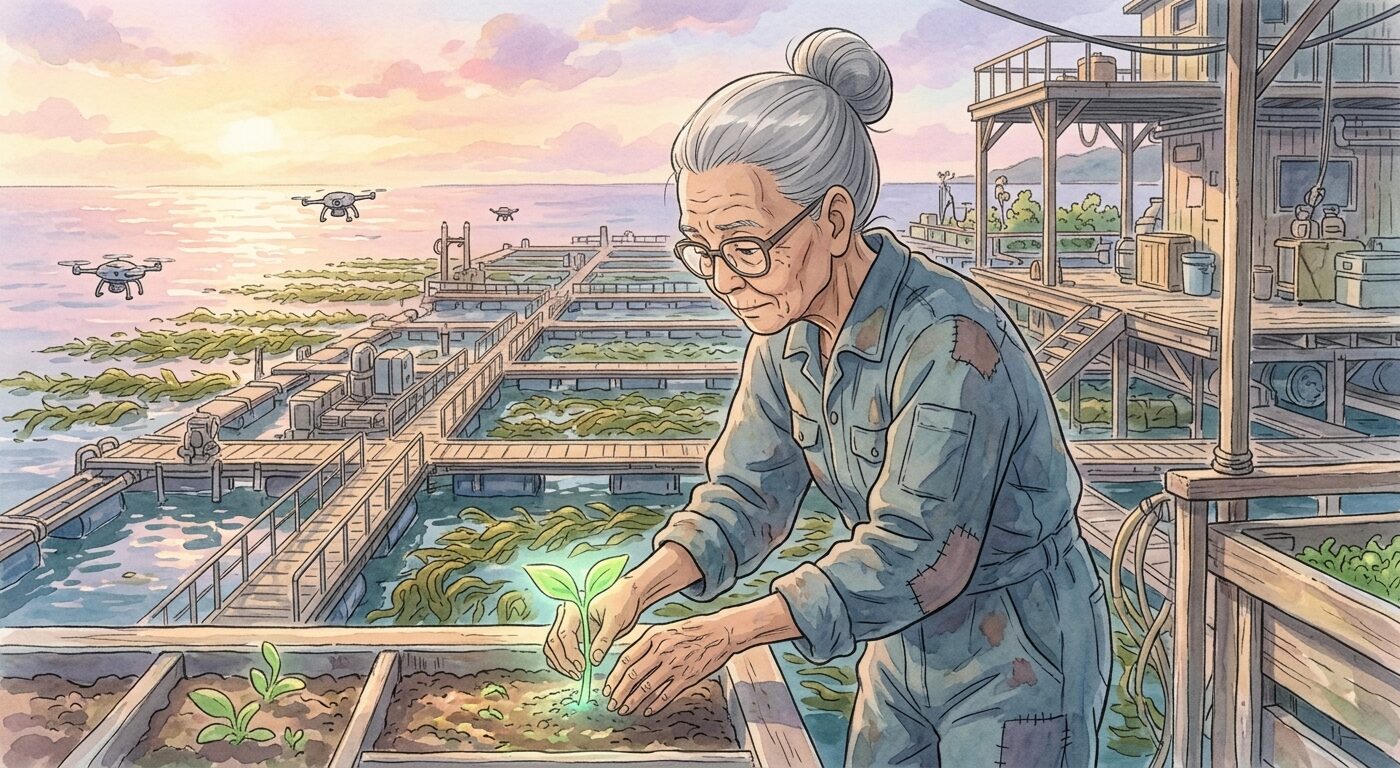
The hum of the Kelpweave Array was a lullaby Nirvi had learned to sleep through, but the sudden silence that followed the drone’s failure was a shout. She woke with a start, the familiar vibration of the hydro-platforms replaced by an unsettling quiet that prickled her skin. Number 73, her oldest sentinel, had gone offline. Again.
Nirvi, an elderly Southeast Asian woman in her late 60s, slender with a stoop, her grey hair pulled into a severe bun, hands gnarled from work, wearing a patched, sea-stained work jumpsuit and thick-rimmed glasses, swung her legs over the cot, the chill of the recycled air-con biting at her bare ankles. The Kelpweave Array was her life, her legacy, her prison. Miles of interlocking platforms, a hydroponic tapestry of greens and browns, floating on an ocean that had long ago swallowed the coasts. She was a drone keeper, an overseer of the automated, submersible harvesters that combed the dense kelp beds, humanity’s last dependable food source.
The journey to Grid Sector Gamma-9 was a routine she could navigate in her sleep, but the unusual quiet amplified every creak of the composite pathways, every distant sigh of the sea. Below her, through the grated walkway, the luminescent fronds of the deep-kelp pulsed with a faint, otherworldly glow. It was beautiful, in a resigned, desperate way. A world remade, not by choice, but by necessity.
She found Drone 73 tangled in a skein of overgrown biomass, its optical sensors dark, its thrusters inert. It had drifted dangerously close to the deep-water thermals, a zone usually avoided by the automated units. Its shell, normally a dull grey, was streaked with an unusual dark green, a slime she didn’t recognize.
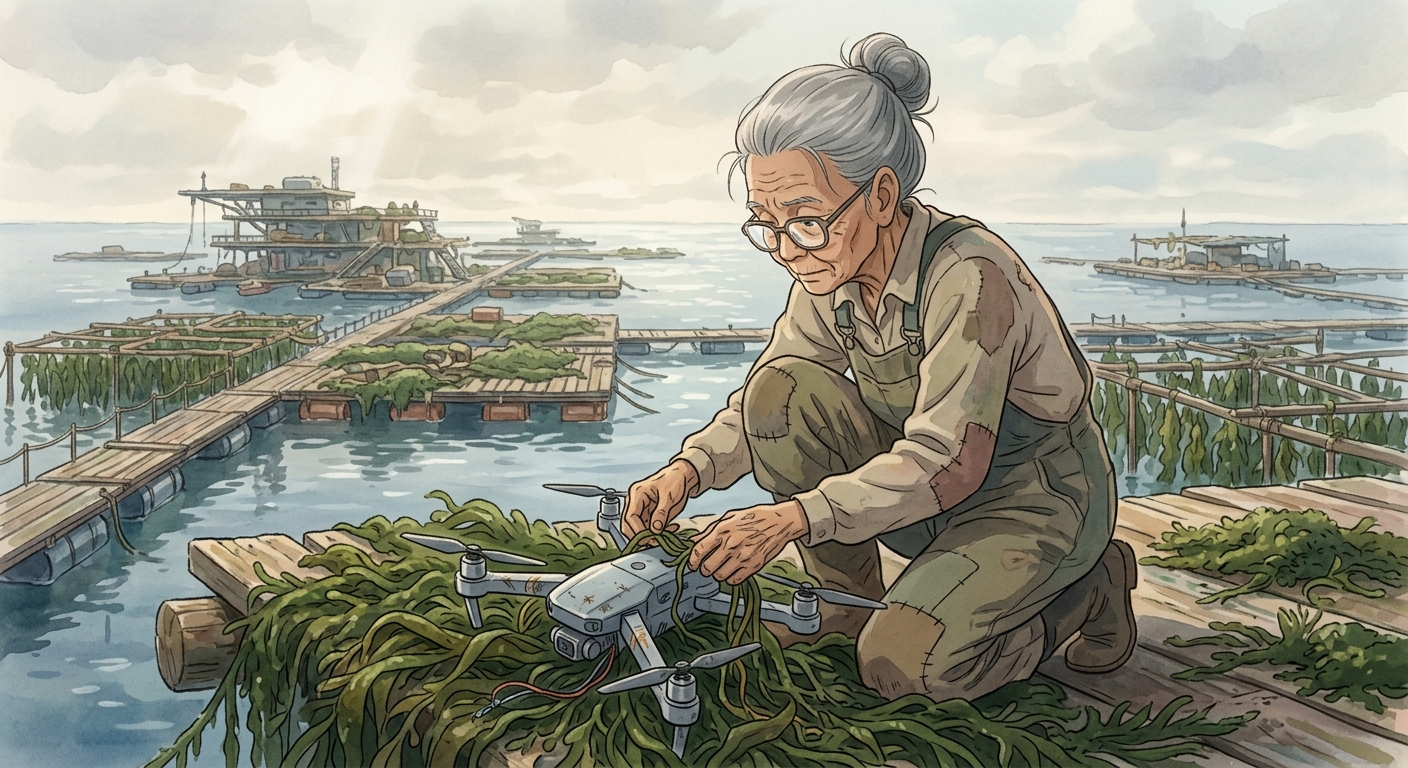
With practiced efficiency, Nirvi tethered herself and hauled the heavy drone to a maintenance bay. The usual diagnostics hummed, then faltered. Not a power issue. Not a systems error. A foreign object, it reported. Carefully, she unsealed the access panel near the drone’s primary sensor array. A strange, almost crystalline substance adhered to the plating, shimmering with an inner light.
Beneath the grime, nestled against the warm metal of the drone’s core, was something else entirely. A seed. Not a kelp spore, those were microscopic, ephemeral. This was solid, embryonic, pulsing with a faint, emerald luminescence. It felt almost warm to the touch, like a tiny heart beating against her calloused finger. It had dug into the drone’s casing, drawing moisture and heat, not unlike a parasite, but with a surprising resilience.
Nirvi gently pried it free. It had the faint, sweet smell of damp earth, a scent she hadn’t encountered in decades. Land-grown. Impossible. All the records said the coastal soil was too saline, too saturated, too toxic. Yet, here it was. A stubborn spark of life, hitchhiking on her old drone.
“Well, little trespasser,” Nirvi murmured, her voice a low rumble. “What are you?”
She spent the next few hours in the small, glass-walled observation room of her living quarters, not repairing drones, but tending to the seed. She fashioned a miniature hydroponic cradle, adjusting the nutrient solution, monitoring the ambient light. It wasn’t her job. Her job was to maintain the efficiency of the Kelpweave, to ensure the constant harvest. This was… extraneous. Reckless, even. But she couldn’t bring herself to discard it.
The tiny seed began to unfurl, a delicate shoot pushing upwards, a vibrant green against the sterile white of the nutrient bath. It wasn’t kelp. It looked like the ancient illustrations of something called a ‘vine,’ a plant that bore fruit, a plant of the solid, forgotten earth. Its roots, initially thin as hair, began to thicken, seeking purchase, stretching towards the light.
“You want to grow,” Nirvi whispered, a rare, soft smile touching her lips. “Even here.”
As the sun dipped below the watery horizon, painting the sky in hues of bruised purple and amber, Nirvi watched the tiny plant. It was a defiance, a stubborn refusal to accept the world as it was. And for the first time in a very long time, Nirvi felt a flicker of something she hadn’t known she’d lost. Not hope, exactly. More like a quiet acknowledgment that even in a world defined by the ebb and flow, some things simply found a way to take root.
She would keep the drone running, of course. Her duty to the Kelpweave Array remained. But now, amidst the monotonous hum and the endless expanse of water, she had another quiet mission. To nurture this tiny, impossible green thing, a silent testament to a world that stubbornly insisted on blooming, even from the depths of oblivion.
What did you think?
Reader Thoughts
No thoughts yet. Be the first to share yours.
Join the conversation
Log in or create a free account to share your thoughts on this story.